
Why Japanese trains are almost always on time
Average delay on the Tōkaidō Shinkansen: 18 seconds. How Japan actually got there, what Brussels could borrow, and what's structurally impossible to copy.
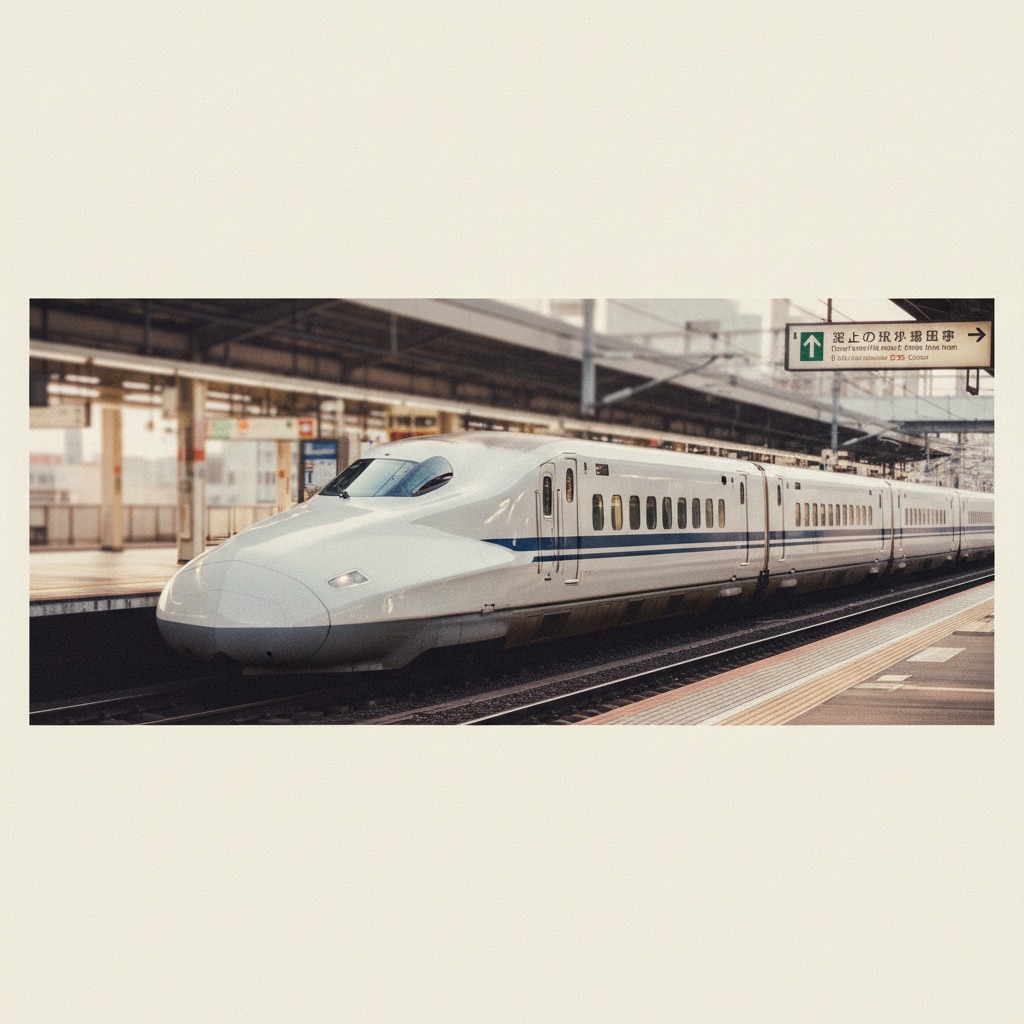
I took the Shinkansen from Tokyo to Kyoto in May. I arrived ninety seconds before my booked train.
The platform was packed. The train pulled in to the exact second. I boarded, sat down, and we left at the exact minute the ticket said.
The whole thing was so calm I almost didn’t register it. Until I thought about what the equivalent SNCB or Thalys would have looked like.
The Tōkaidō Shinkansen - Japan’s bullet-train spine connecting Tokyo to Nagoya, Kyoto and Osaka - has an average per-train delay of around 18 seconds. JR Central publishes this annually and it’s audited by Japan’s transport ministry.
Eighteen seconds, on a network covering hundreds of kilometres a day.
Quick version
- Japanese train punctuality is the result of three things stacked: infrastructure built for it, operational discipline so deep it looks ceremonial, and a culture that won’t tolerate it being any other way.
- You can copy the first two. The third is the hard part.
- STIB and SNCB measure punctuality within a 4-6 minute tolerance window. Japan measures in seconds of delay against the timetable.
The number that breaks European brains
Eighteen seconds is statistically impossible at that volume - unless you define “on time” differently.
Japanese punctuality is measured in seconds of delay against the timetable. Not against an “acceptable window.” If a Shinkansen is scheduled to depart at 08:14:30 and leaves at 08:14:48, that’s 18 seconds of delay, and it gets recorded.
STIB, SNCB, Deutsche Bahn and SNCF all measure within tolerance windows. That’s a measurement choice, not a physical one. It lets a 5-minute delay disappear from the statistics.
If Brussels measured the same way, the headline number would be much worse - and probably more useful.
The infrastructure that makes it possible
Japan didn’t get to 18-second precision by willpower. Decades of infrastructure choices made it achievable.
- Freight on separate lines. In Belgium, freight trains share the same tracks as passenger trains. One slow freight can hold up the whole line. In Japan, freight runs on dedicated tracks or moves at night.
- Dedicated commuter lines. Shinkansen runs on completely separate tracks from local commuter trains. Local commuter networks in Tokyo and Osaka are built around frequency - the assumption is “a train will come in 3 minutes,” not “the train will come at 8:14.”
- Modern signalling. Most major Japanese lines use ATC and CBTC systems that allow precise spacing. Trains can run 90 seconds apart safely.
- Platform design for fast turnover. Markings tell passengers exactly where each carriage door will stop. Queueing happens before the train arrives. Boarding takes 30 seconds.
- No level crossings on major lines. Anywhere with a level crossing has unpredictable delays. Japanese major lines have eliminated almost all of them.
Belgian and French networks have been retrofitting these things for thirty years and still aren’t done. It’s the most boring reason Japanese trains run on time. Probably the most important.
Operational discipline that looks ceremonial
Standing on a Tokyo platform watching a single train cycle, you see things that look strange until you understand them.
Pointing and calling. The conductor points at a signal, then says out loud “signal green.” Points at a gauge: “doors closed.” Points at the platform: “no obstacles.” This is shisa kanko. It looks theatrical. It’s not. A 1994 study by Japan’s Railway Technical Research Institute found that pointing-and-calling reduced error rates from 2.38 to 0.38 per 100 actions - an 84% reduction. The simple act of physically moving your finger to what you’re checking forces your brain to actually check it.
Conductor and driver bows. When the conductor hands the train over to the driver at the start of the route, both bow. When the driver boards the cab, they bow. When they leave, they bow. Not just polite ritual - a deliberate handover protocol with no ambiguity about who’s in charge.
Dispatcher schedule recovery in real time. If a train falls 90 seconds behind, a control room dispatcher adjusts the next three trains by 30 seconds each to absorb it. Passengers don’t notice. The schedule recovers within ten minutes.
Cleaning crews that finish in 7 minutes. The famous Tessei cleaning teams turn around a Shinkansen at Tokyo Station in 7 minutes - 17 carriages, 22 people, bowing to the train, boarding, cleaning, rotating seats, exiting before the next departure. Watch a Tokyo Station turnaround once. It changes how you think about what’s possible in public transport.
The cultural layer - what Brussels can’t borrow
Some of what makes Japanese trains run on time isn’t infrastructure or process. It’s that the entire society would consider it a serious problem if they didn’t.
When a Japanese commuter train is more than 5 minutes late, the operator issues a printed certificate - the chien-shomeisho - which the commuter can show to their employer. Millions are issued per year across the network. The piece of paper exists because the social cost of being late to work in Japan is high enough that there has to be an external way to prove it wasn’t your fault.
When a train is over 30 minutes late, the operator’s executives have, on occasion, publicly bowed at press conferences and apologised. Some have resigned over major delays.
The more famous incident: in May 2018, JR West issued a written apology after a commuter train departed Notogawa Station 25 seconds early. Widely shared abroad as parody of Japanese train discipline. Completely sincere internally.
You can find this funny from a European distance, but the underlying social contract is real. If you assume passengers will tolerate a 5-minute delay, the system delivers 5-minute delays. If you assume they will publicly shame you for 30 seconds of delay, the system delivers 30 seconds.
Japan chose, decades ago, the second assumption.
You can’t legislate “your population should consider a 4-minute delay a serious failure.” That’s residue of a long social agreement.
What Brussels and STIB could borrow
Some of this is genuinely transferable, and would cost less than people assume:
- Measure differently. Stop reporting “on-time within tolerance” and start reporting average seconds of delay per departure. Publish it. The number will be embarrassing the first year and useful every year after.
- Get freight off passenger tracks where physically possible.
- Standardise pointing-and-calling for tram and metro drivers. Cheap, fast, evidence-based.
- Platform markings and queue zones. Mark where each carriage door will stop. Mark queue lines. The cost is paint.
- Real-time dispatcher schedule recovery. Modern dispatching software can do this. SNCB has some of it.
- A public-facing dashboard showing, in real time, which lines are within their punctuality budget for the month.
None of these require Belgian commuters to become Japanese. They require Belgian operators to set a higher bar for themselves.
What surprised me most
The quietness inside the train. (Whole separate post on that.)
The drivers actually do bow. The first time you see a driver at a terminus turn to face the empty platform and bow before stepping off, you assume it’s for someone you can’t see. It isn’t. It’s for the train, and for the act of having driven it. It’s odd and a bit moving.
The instant calibration when something goes wrong. One day a small fault on a Yamanote train produced a 12-minute delay. Platform staff was already on the speakers explaining what had happened, what was being done, when the next train would arrive. No vague “service interruption due to a technical incident.”
Practical thoughts
- Assume the train will be on time. Don’t pad your transfers.
- If the train is late, the platform staff will tell you exactly why and when the next one is coming.
- If you’re catching the Shinkansen, be on the platform 5 minutes before. Trains depart on the second.
- The last train is the last train. There is no replacement bus.
- If your train is more than 5 minutes late, ask the station staff for a chien-shomeisho. A fun souvenir of how seriously this is taken.
FAQ
Are Japanese trains ever late?
Yes, occasionally. Typhoons, earthquakes, snowstorms and the occasional accident cause real delays. What’s unusual is everyday small delays - those simply don’t accumulate the way they do in Europe.
What happens if I miss the last train?
Taxi, capsule hotel, or wait for the first train at 5am. Tokyo has a thriving “missed last train” ecosystem.
Is the JR Pass still worth it?
Depends. The 2023 price increase made it more borderline. For a 2-week trip that includes Tokyo-Kyoto-Hiroshima-back, still usually worth it.
Closing thoughts
The 18-second average isn’t a Japanese mystery. It’s decades of infrastructure investment, a tightly designed operational discipline, and a society that decided to take it seriously.
The last layer is the one Europe can’t import. The first two are partly on the table for any serious operator.
Coming back to a STIB platform after three weeks of Tokyo metros has the same body-recalibration moment I wrote about for street safety. You don’t notice how much friction the system creates until you’ve spent a few weeks without it. The good news is that the friction is, mostly, removable.