
Working remotely from Seoul for two months: why I'm doing it
I'm spending two months working remotely from Seoul as a Brussels-based freelancer. Here's why I chose Korea, how I'm planning my schedule, and what this blog will be about.
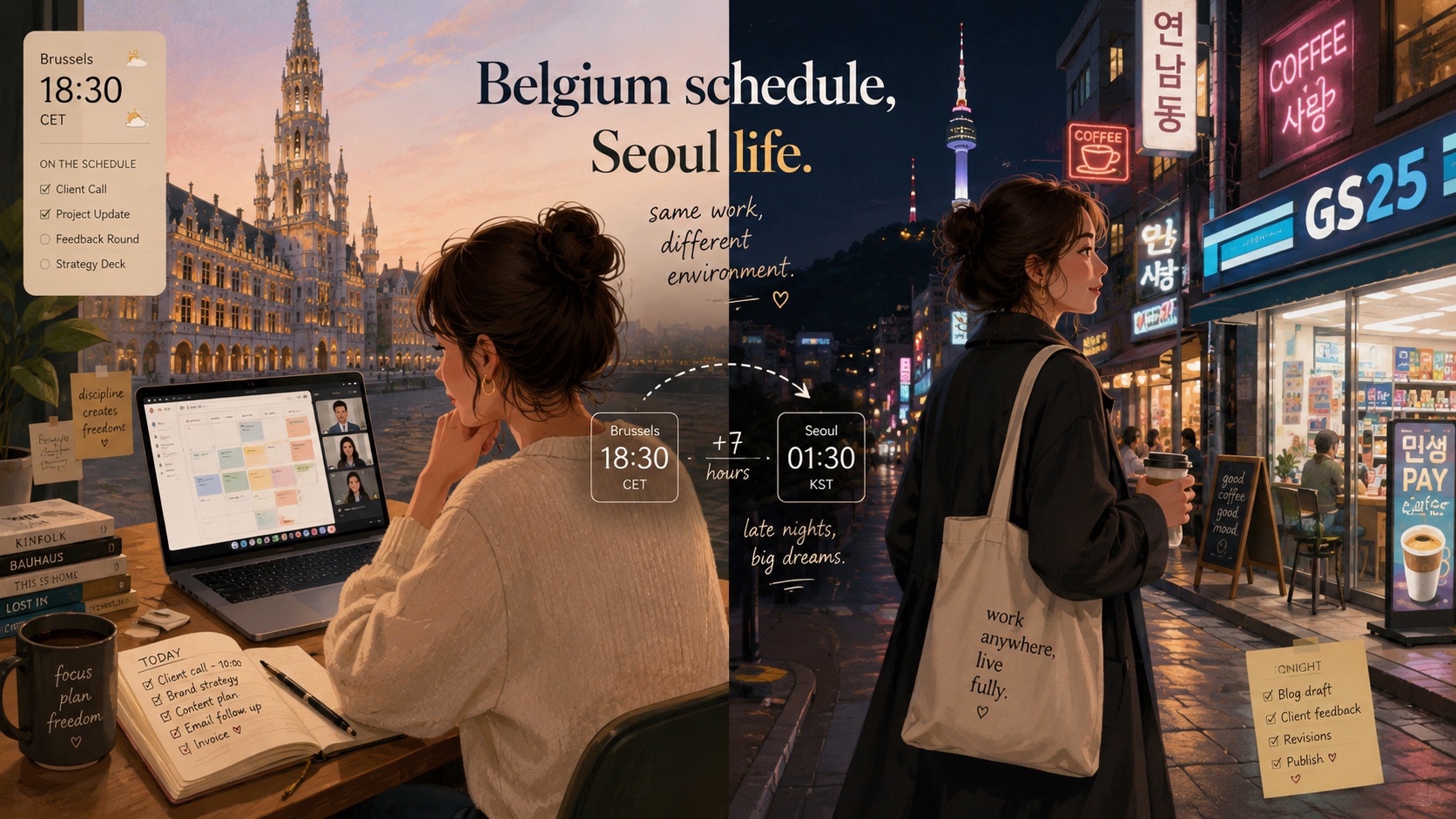
I landed in Seoul yesterday with one suitcase, my laptop, and a calendar that is already way too full.
For the next two months, I'll be working from a small apartment in Gangnam-Seocho while keeping my normal client work in Europe and the US. So no, this is not really a holiday. It's also not the cute digital-nomad fantasy where you work two hours in a café and spend the rest of the day exploring.
It's Q4 in digital marketing. For most of my clients, that means Black Friday, big budgets, a lot of pressure, and many decisions to make quickly. So the work is very much still there.
The only difference is that my desk moved to Seoul.
And honestly, that's exactly what I wanted to test.
The quick version
I'm spending two months in Seoul, from September 19 to November 4.
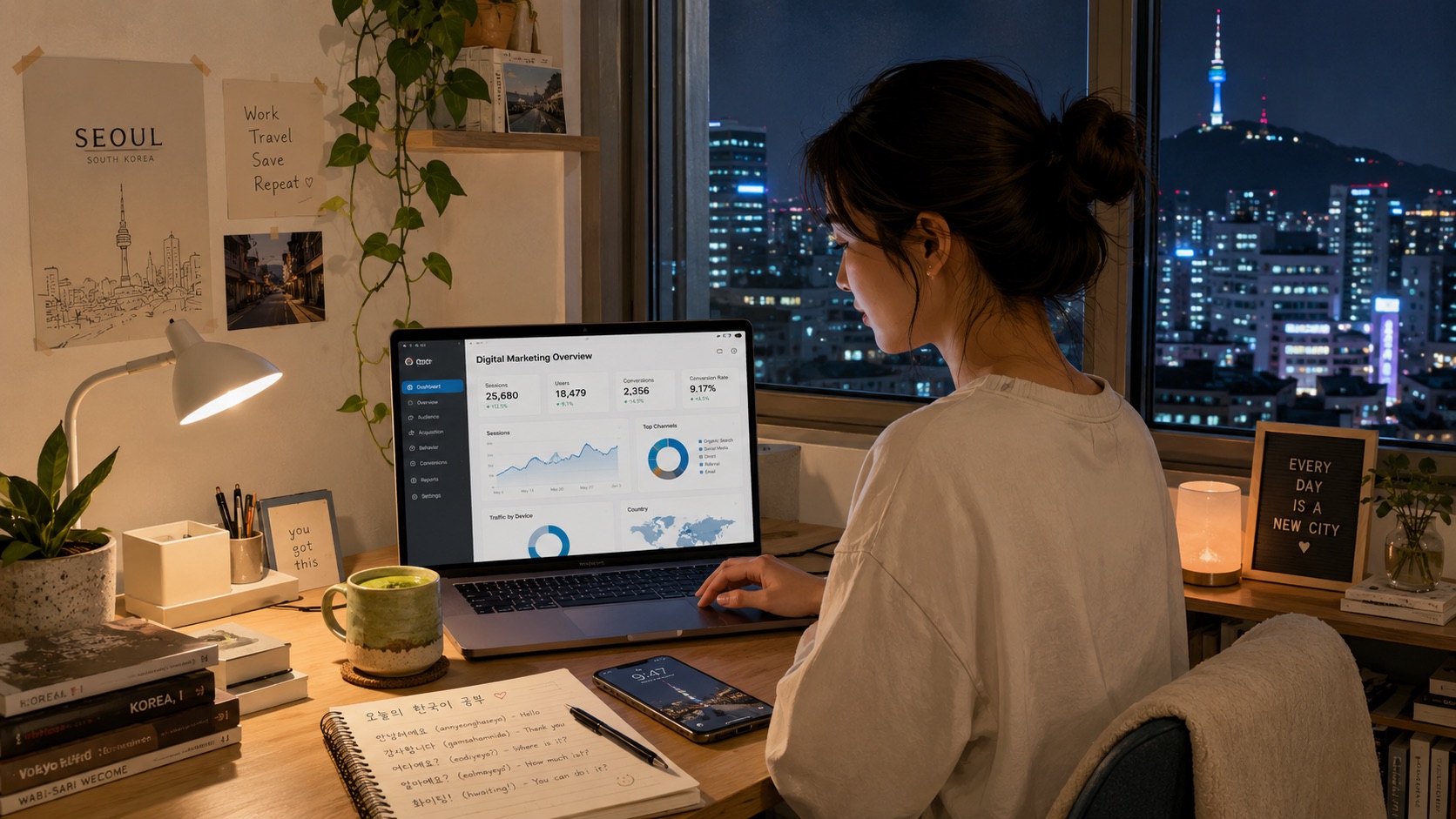
I'm staying in Gangnam-Seocho, going to Korean classes in the morning, and working for my clients in the afternoon, evening, and sometimes very late at night.
I chose Seoul because it already feels a little bit familiar to me. I've been here before, I can read enough Korean to survive menus and metro signs, I love the food, and the city works well when your schedule is not exactly normal.
This blog will not be a "Top 10 things to do in Seoul" type of blog.
I want to write about Japan and South Korea through my own eyes: as someone from Belgium, working in marketing, who notices small details and keeps asking one question:
Why does this work here - and could we learn something from it in Europe?
Why Seoul?
The honest answer is: because I wanted to come back.
I've always had something with South Korea. The food, the cafés, the city rhythm, the language, the skincare, the little systems that somehow make daily life easier. I'm not saying Korea is perfect - because it's not. But there are many things here that make me curious.
And that's the feeling I wanted again.
At the same time, I needed to be realistic. I'm not in a period of life where I can just disappear for two months. I have clients, deadlines, campaigns, meetings, and responsibilities.
So instead of waiting for the "perfect moment" to travel, I decided to test something else: what if I keep working, but from a place that gives me more energy?
That's really what this trip is about.
Not escaping work. Changing the environment around it.
My setup here
Practically, the plan is quite simple.
I'm staying in a small furnished apartment in Gangnam-Seocho. It's quiet, close enough to the metro, and there's a convenience store nearby, which already makes life easier.
In the morning, I'll go to Korean classes at EF International School. I'm doing this partly because I want to improve my Korean, but also because I know myself. If I don't have something planned in the morning, I could very easily stay inside and work directly.
The classes give me structure.
Then from the afternoon, I work.
Because of the time difference, my European clients start their day when it's already afternoon here. And for US clients, it can go very late. Some days will probably end around 2 or 3am.
So yes, the schedule is intense.
But Seoul is one of the few cities where this kind of rhythm doesn't feel completely impossible. You can still get food late. You can still go outside. You can still find cafés, convenience stores, lights, people, and a feeling that the city is not completely closed just because your workday ended late.
And that makes a difference.
What this blog will be about
I created this blog because I don't just want to travel and forget everything after a few weeks.
I want to pay attention.
There are many things in Japan and Korea that feel small at first, but actually say a lot about how a country works. Public transport. Convenience stores. Food culture. Service. Safety. Skincare. Technology. Public spaces. The way people behave in cafés, shops, trains, or restaurants.
And because I'm from Belgium, I automatically compare.
Sometimes Europe does things better. Sometimes Korea or Japan does. Most of the time, it's more nuanced than that.
That's what I want to write about.
Not in a "everything is amazing here" way.
More like: this surprised me, this works well, this doesn't, and this is what Europe could maybe learn from it.
What this blog will not be
It will not be a perfect travel guide.
I don't want to pretend I know everything about Korea after a few trips and two months here. I'm still learning. I'll probably get some things wrong. My opinion might also change between the first week and the last week, and that's fine.
It will also not be a digital-nomad blog selling a dream.
I'm still working full-time. Some days, I'll probably be too tired to do anything interesting. Some weekends, I'll just want coffee, food, and a walk.
And honestly, that's also part of the experience.
Because working from another country is not only about the beautiful moments. It's also about laundry, bad sleep, finding groceries, doing calls at weird hours, missing people, and trying to create a routine somewhere new.
What I expect to learn
I'm curious to see how my idea of Seoul changes when I'm not just here as a tourist.
I want to see what daily life feels like when you stay in one neighborhood, go to class, work, buy groceries, go to the same cafés, and slowly build small habits.
I also want to see if this kind of setup is actually sustainable for me.
Can I work from Asia without burning out?
Can I enjoy the city even with a full client load?
Can Korean classes fit into a busy work schedule?
Can I feel more inspired just because my environment is different?
I don't know yet.
That's also why I'm writing this blog.
A few practical thoughts already
If you're a freelancer and you're thinking about working from another country, I don't think the first question should be: "Will I have a lot of free time?"
Because realistically, maybe not.
The better question is:
Does this city support the life I need to live while I'm working?
For me, that means: safe streets, late food options, good public transport, cafés, fast internet, and enough things around me to feel like I'm still experiencing the place, even on busy days.
That's why Seoul made sense.
Not because it makes work disappear.
Because it makes the heavy work period feel a little lighter.
FAQ
Is Seoul a good city to work remotely from?
Yes, Seoul can be a great city to work remotely from, especially if you like cafés, good public transport, fast internet, and a city that stays active late. For me, it works well because I can take Korean classes in the morning and work with European and US clients later in the day.
How do you manage the time difference between Europe and Korea?
The time difference means my workday starts later than usual. I usually keep my mornings for Korean classes or personal time, then work from the afternoon until late evening or night. It’s not always easy, but it works because Seoul makes late routines easier than many European cities.
Why did you choose Seoul instead of another city?
I chose Seoul because I already felt connected to the city. I like the food, the cafés, the language, the safety, and the general energy. It also felt like a good place to test whether I could keep working for my clients while living in a completely different environment.
So, what now?
For the next two months, I'll write about what I notice.
Some posts will be practical. Some will be more personal. Some will compare Korea, Japan, Belgium, and Europe. Some will probably just start from one small thing I saw in the street and couldn't stop thinking about.
I don't want this blog to be perfect.
I want it to be honest.
So this is the start: one suitcase, one laptop, one Korean class schedule, too many client meetings, and two months in Seoul to see what happens when work stays the same but life around it changes.