
Why nobody talks on Japanese trains
It isn't a law. It isn't even a strict rule. It's a single cultural instinct applied at scale. Once you see it, the calm makes more sense than the silence.
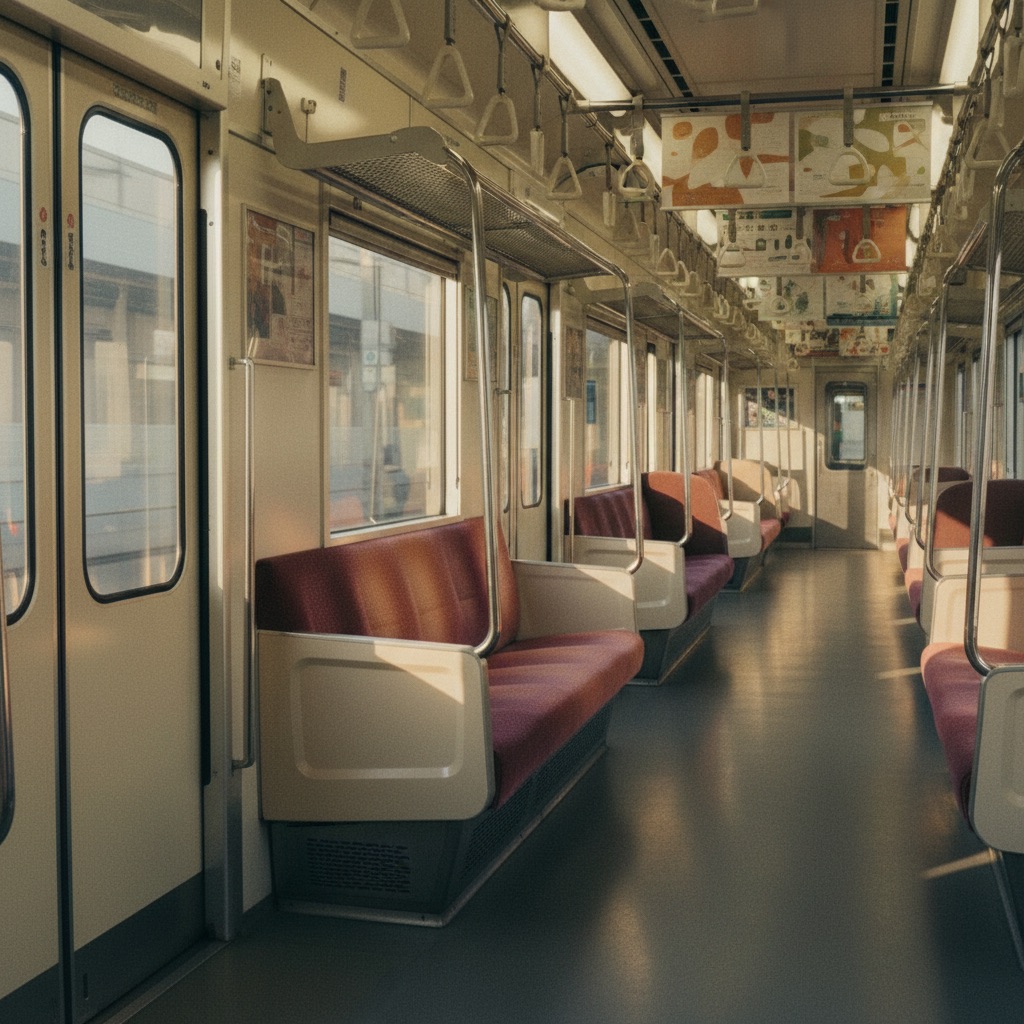
I stepped into a packed Tokyo metro car at rush hour and my brain did a small double-take.
Two hundred people in this carriage. I could hear the announcement clearly from the back. Two teenagers in the corner were texting. A businessman reading. A mother gently holding her child’s hand.
Nobody was talking. Nobody was on the phone. The loudest thing in the car was the air conditioning.
This is the moment every European visitor has the same question: is this banned?
The answer is no.
Quick version
- It isn’t banned. Quiet conversation between friends is acceptable.
- What is socially discouraged is phone calls. Announcements ask passengers to set phones to silent and refrain from calls. Most do.
- The deeper reason is meiwaku: don’t bother strangers. A packed train means hundreds of strangers within earshot. Volume adjusts down accordingly.
- The silence is not oppressive. After a week, it’s calming.
It isn’t actually banned
Japanese trains don’t have a “no talking” rule. There’s no sign that says “silence in the carriage.” Two friends talking to each other at low volume are doing nothing wrong. You’ll see it constantly.
School kids whisper-laughing on the way home. A couple discussing dinner. Colleagues going through a presentation.
The behaviour that’s strongly discouraged is phone calls.
Every Japanese train operator plays a regular announcement asking passengers to silence their phones and refrain from voice calls. Most operators specifically ask people to avoid calls in the priority seat areas at the end of each car. (JR East and Tokyo Metro relaxed the strict “power off near priority seats” rule in October 2015 - phone use is now permitted in those areas except during rush hour.)
So the right question isn’t “why is talking banned?”
The right question is: why does everyone keep their voice so low even when they could talk normally?
Meiwaku applied to packed trains
If you’ve read the Japan unwritten rules post, you know meiwaku. The principle that you should not cause inconvenience to strangers.
Now apply it to a Tokyo metro at 8:45am.
Two hundred people pressed into a confined space. Most are tired. Most are deep in their own thoughts, their phones, a book.
The default expectation: this carriage is essentially a quiet shared space. Anyone speaking is borrowing attention from people who didn’t choose to give it.
Speaking softly to one friend is fine. Your voice doesn’t carry.
Speaking loudly is rude.
Speaking on the phone is doubly rude because it makes the people around you involuntary participants in a one-sided conversation.
That’s the whole logic. Once you see it that way, the silence stops feeling like a rule and starts feeling like a social courtesy applied honestly.
What the announcement actually says
Every few minutes a Japanese train plays a recorded announcement. The English version says something like “please refrain from talking on your mobile phone.”
The Japanese version, more literally, says: “in order to avoid causing inconvenience to other passengers, please switch your mobile to manner mode and refrain from voice calls.”
The word meiwaku is right there.
The operator isn’t asking you to follow a rule. They’re naming the social value and trusting passengers to act on it.
By contrast, the STIB announcement about phones simply says “don’t disturb other passengers.” Same idea. Without the cultural anchor.
Why the silence is calming, not oppressive
Visitors expect to find the silence creepy. They almost never do. Within a few days, the opposite happens.
The reason: the cognitive load of being in public is largely the load of involuntary attention. Every loud conversation, every phone call, every burst of laughter pulls your attention away from your own thoughts.
A train car where nobody is doing this is a train car where you can think. Read. Plan. Daydream.
The high density doesn’t feel intrusive because the social density - the attention you’re forced to spend on other people - is low.
I read more on Tokyo trains in three weeks than I had on Brussels metros in three months. Same time spent. Different quality of time.
How Seoul compares
Korea is closer to Japan than to Europe on train behaviour, but not the same.
The Seoul metro is quieter than Brussels but louder than Tokyo. Quiet phone calls happen routinely - shorter than European calls, lower volume, but they happen. Groups of friends hold normal-volume conversations.
The reason: Korean public space is more communal and a bit more visible than Japanese public space. Speaking is fine.
If you’re coming from Seoul to Tokyo, the volume drop on the metro is noticeable from day one. From Tokyo to Seoul, you feel the volume go up, and probably enjoy it.
What changes when foreigners enter the car
You can spot a group of European tourists on a Tokyo metro before you see them.
They’re the ones speaking at a volume perfectly normal in Brussels and deafening in Tokyo.
This isn’t rude per se - it’s just calibrated to a different baseline.
Japanese people are mostly forgiving. The looks you get aren’t angry. They’re confused: why is this carriage suddenly so loud?
The right move, if you’re travelling in a group: consciously match the volume of the carriage. Look at the local people around you. Listen to how their conversations sound. Adjust.
Within a few days you’ll do this automatically.
The Shinkansen is gentler
Train silence in Japan is most rigorous on commuter rail. Shinkansen culture is softer.
People eat bento. People drink beer. People chat at low volume. The “no phone calls” rule still applies - you’ll see passengers step into the corridor between carriages to take a call. But the default volume is higher than on a commuter train.
The logic is the same meiwaku principle, applied to a different context. On a commuter train, everyone is tense, tired, hurried. On a Shinkansen, everyone is settling in for a long trip. A bit more social warmth is acceptable.
What I miss most back in Brussels
The phone calls.
Specifically, that nobody on the Brussels metro thinks twice about taking a 15-minute call at normal volume, broadcasting half a conversation to 60 people who didn’t ask.
After three weeks in Tokyo, this feels antisocial in a way it didn’t before. It isn’t antisocial in some objective sense - Belgian norms are different and that’s fine - but the contrast is sharp once your body has experienced both.
The other thing I miss: the calm.
A 25-minute commute in Tokyo is genuinely restful. The same commute in Brussels is, in my body, more tiring than it should be. The reason isn’t the train. The reason is the noise.
Practical thoughts
- Don’t take phone calls on Japanese trains. Set your phone to silent. If a call comes in, decline and step off at the next station.
- Conversation is fine, just at low volume. If the person two seats away can hear you, lower the volume.
- Headphones at moderate volume. If someone next to you can hear it, it’s too loud.
- Backpacks come off in crowded cars. Hold them at your feet or in front.
- Travelling in a group? Match the volume of the carriage. Don’t be the European tourist group that turns one car into the loud one.
FAQ
Can I talk to my friend on a Japanese train?
Yes, quietly. Two people having a low-volume conversation are doing nothing wrong. The behaviour that’s off-limits is phone calls and high-volume group conversation.
What if I have to take an emergency call?
Step off at the next station, take the call, get back on the next train. Almost every Japanese station is two minutes from the next one. This is what locals do.
Does this apply to buses too?
Yes, but with slightly more leeway. Buses are generally quieter than European buses but noticeably less silent than trains.
Closing thoughts
The silence on Japanese trains isn’t a rule.
It’s a courtesy applied consistently because the underlying value - don’t impose yourself on strangers - is broadly shared. When the value is shared, the system runs itself. No enforcement needed.
The deeper lesson, beyond the trains themselves: a lot of public behaviour can’t be legislated. Only modelled.
Japan modelled this one early and stayed with it. The result is a daily commute that quietly restores rather than drains, in the densest urban transport system in the world.
If you’ve ever come off a 30-minute Brussels metro with the energy of a 90-minute meeting, you already know exactly what I’m describing.
After three weeks in Tokyo, you stop accepting that as inevitable.