
Unwritten rules in Japan: what I noticed on my trip
Three weeks in Tokyo, Kyoto and Hakone. The small social rules I noticed - trains, eating, onsen, photography, daily life. Honest, not a checklist.
I spent three weeks in Japan in May 2026.
Tokyo first (apartment in Minato). Then Kyoto (the Smart Place Inn near Shijo Omiya). Then Hakone for a private-onsen night at Senkei.
What I noticed about Japanese social rules: they look like a long list from outside, but inside they’re mostly one idea applied many times.
The idea is a Japanese word, meiwaku. It means “bother” or “nuisance to others.” Causing meiwaku is the worst social mistake you can make in Japan.
Most everyday etiquette flows from one question: am I about to bother someone I don’t know?
Once you carry that question with you, almost everything else falls into place.
Quick version
- Don’t cause noise, mess or delay for strangers. That’s meiwaku.
- When in doubt, copy the local person next to you.
- Japanese people are extraordinarily forgiving toward visitors who try. Effort matters more than precision.
Trains: the quietest place I’ve been
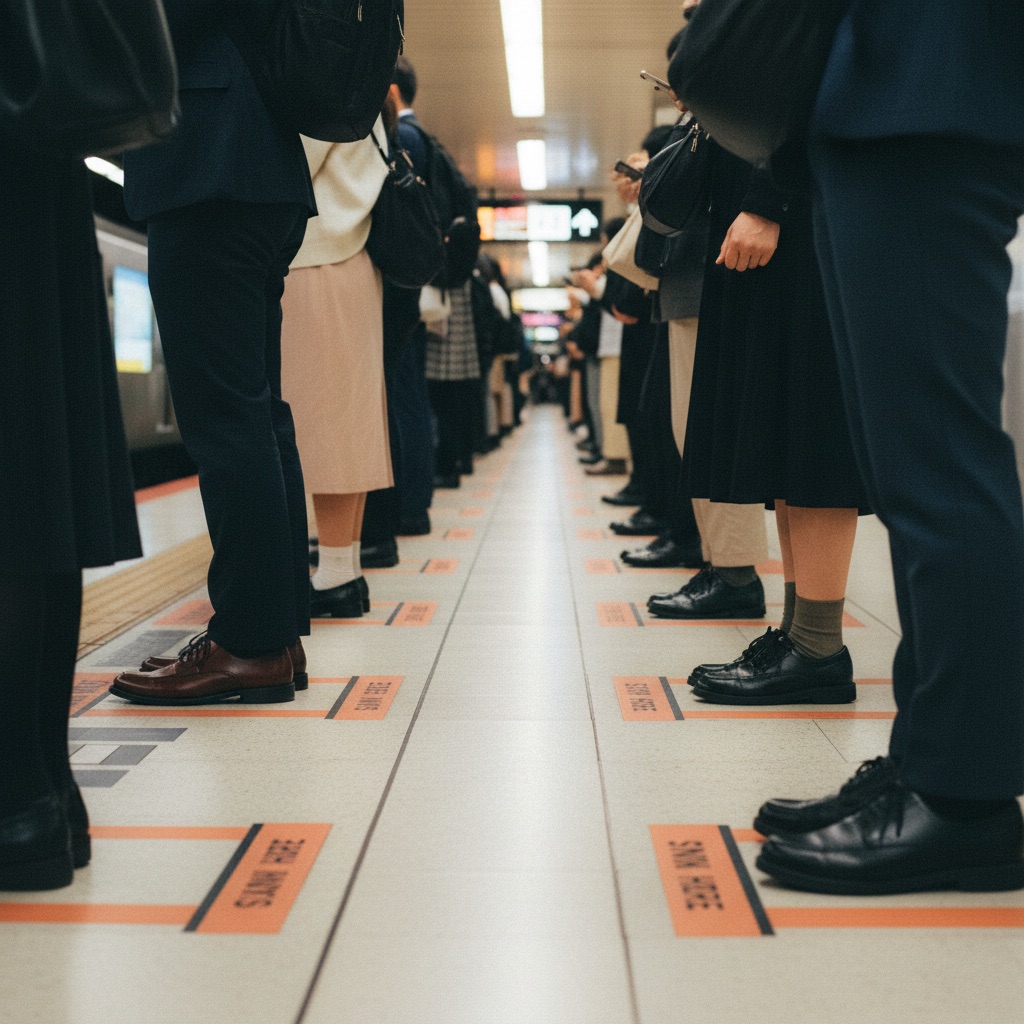
The biggest shock for me was how silent a packed Tokyo metro car can be.
Sixty people, shoulder to shoulder, and you can hear the announcement perfectly from the back. That’s not law. It’s meiwaku applied at scale.
- No phone calls. Texting, emails, watching videos with headphones - all fine. Holding a phone to your ear - never. If your phone rings, refuse the call and step off at the next station.
- Headphones at low volume. If someone next to you can hear what you’re listening to, it’s too loud.
- Quiet voices. Especially in groups. Tourists laughing loudly is the most consistent giveaway that newcomers are on the train.
- Priority seats. The seats at the end of each car are reserved for the elderly, pregnant women, people with young children, people with disabilities. Sit there if it’s empty - but stand up the moment someone who needs it boards.
- Women-only carriages exist on most major lines during morning rush hour. Marked in pink. Men: don’t.
- Don’t eat or drink on commuter trains. A sip of water is fine. A sandwich is not. The exception: Shinkansen and other long-distance trains, where eating bento is part of the experience.
Eating
Restaurant etiquette is the one most travellers get anxious about. They shouldn’t. The rules are forgiving and staff are professionally kind.
- Don’t tip. Ever. Anywhere. No restaurant, no taxi, no hotel. Tipping is mildly offensive in Japan.
- Slurp your noodles. Ramen, udon, soba - slurping is correct, expected, and improves the flavour by aerating the broth.
- Don’t pour your own drink in a group. The person next to you fills your glass. You fill theirs.
- Don’t stick chopsticks vertically into rice. That’s the funeral arrangement for offerings to the dead. Lay them on the rest.
- Don’t pass food chopstick-to-chopstick. Same reason. Put it on a plate first.
- Walking and eating is mildly frowned upon. Eat near where you bought it, not while walking three blocks.
- The wet towel (oshibori) at the start of the meal is for your hands. Not your face. Definitely not the table.
Onsen and sento: the rules everyone is most nervous about
Communal bathing was one of my favourite parts of the trip. Hakone’s private-onsen room at Senkei was a quiet highlight.
The rules around onsen are the most rigid - because the whole system collapses if anyone fails them. Worth taking seriously.
- Wash thoroughly before entering the bath. Every onsen has a row of shower stations. Sit on the small stool, wash your entire body, rinse off all soap. The bath is for soaking, not washing.
- No swimsuits. Communal onsen are nude. Gender-separated. Everyone is naked, no one cares, and within five minutes you forget about it.
- Don’t put the small towel in the water. Fold it and put it on your head, or on a rock at the edge.
- Tattoos are a real complication. Many traditional onsen refuse entry to visibly tattooed visitors. Smaller tattoos can sometimes be covered with a patch (available at konbini). Some Tokyo and tourist-area onsen now allow tattoos. Check before you go.
- Don’t dunk your hair. Tie long hair up.
- Be quiet. Onsen are for relaxation, not socialising.
If you’ve never been, start with a clean modern sento in Tokyo before a remote rural onsen. Same protocol, lower stakes.
Shoes: where they come off
Houses, traditional restaurants, temples (sometimes), some museums, and increasingly some shops - you take your shoes off.
The signal: usually a step up from one floor level to another, often combined with a row of slippers facing outward.
- You’ll be given indoor slippers. Don’t wear them onto tatami floors - tatami is bare-feet or socks only.
- Bathrooms have a separate pair of slippers waiting inside. Switch when you enter the bathroom, switch back when you leave. Forgetting and walking out in toilet slippers is a small classic comedy moment.
- Hotel rooms (Western-style) generally don’t require this. Ryokan always do.
Cash and IC cards
Japan is famously fond of cash, though the situation has improved.
- Get a Suica or Pasmo IC card in the first hour. They handle every train, bus and metro across the country, and most convenience store purchases. You can issue a digital Suica on your iPhone wallet for free.
- Carry ¥10,000-20,000 in cash. Many small restaurants, ryokan and rural ATMs still don’t take foreign cards.
- Withdraw at 7-Eleven ATMs. Honest exchange rates, support every major foreign card, English interface.
- Tap-to-pay credit cards work at major restaurants, chain shops and konbini. Smaller restaurants - cash only.
Photography: where to be careful
Japan is one of the most photogenic countries in the world and most people are relaxed about being in the background of your shots.
- Don’t photograph geisha or maiko in the private alleys of Gion. Kyoto explicitly banned photography in the small private alleys off Hanami-koji in October 2019 (¥10,000 fine), and expanded restrictions in April 2024. The main public streets like Hanami-koji and Shirakawa-dori are still fine. Long lenses pointed at the private alleys are particularly bad.
- Ask before photographing strangers in close-up. A small smile and a raised camera is usually enough.
- Most temples allow exterior photography but not inside the main hall. Look for the crossed-camera sign.
- Don’t photograph people praying.
The vocabulary that does most of the work
You don’t need to speak Japanese. You do need three words.
- Sumimasen (すみません). “Excuse me / sorry / thank you for the inconvenience.” Works in almost any situation.
- Arigatō gozaimasu (ありがとうございます). The full, polite “thank you.”
- Onegaishimasu (お願いします). Roughly “please / I’d like.”
Those three plus a small bow will carry you through 90% of interactions with strangers.
The fourth useful word is daijōbu (大丈夫) - “it’s fine / I’m okay / no thanks.” Politely declines anything.
What surprised me
The thing nobody warned me about: how much social work is done by quiet bowing. Not the deep ceremonial bow - the small, almost reflexive nod that happens dozens of times per hour.
The cashier nods at you, you nod back. You step out of someone’s way, they nod, you nod. It’s an entire micro-language of acknowledgment that doesn’t really exist in Brussels.
By day four I was bowing at vending machines.
The other surprise: how forgiving everyone is. Japanese people are genuinely happy when foreigners try, even badly. A wobbly arigatō gozaimasu earns a smile. A confused attempt to figure out the ticket machine earns help.
Practical thoughts
- Internalise meiwaku: don’t be a bother. Most rules collapse into that one.
- When you don’t know what to do, look at the local person next to you and copy.
- Quieter than you think - on trains, at restaurants, in temples.
- Carry cash. Get an IC card immediately. Know where the 7-Eleven ATM is.
- If you mess up: smile, apologise, move on. Japanese people are not keeping score.
FAQ
Will I offend someone if I make a mistake?
Almost never. Japanese people are aware tourists won’t know every rule and grant generous leeway. The unforgivable mistakes are loud disrespect in temples and onsen - the rest is forgiven on sight.
Do I need to learn Japanese?
No. English signage in major cities is excellent. Google Translate’s camera mode handles menus. Three words plus a small bow carry you through almost everything.
Is tipping really not done?
Really. Leave nothing in restaurants, taxis or hotels. The closest acceptable gesture is a polite thank you with a small bow.
Closing thoughts
Japan’s social rules can look like a long list. They aren’t. They’re a single instinct - don’t be a bother - applied politely and consistently across a hundred small situations.
If you carry that instinct with you when you land, the rest sorts itself out.
And the country, for all its reputation for strictness, meets you halfway with more patience than you’d expect.