
T-money vs Suica: why Korea’s transit card is the one thing that isn’t smooth
Korea has the most digitally integrated daily life I've used. And its transit card is meaningfully more annoying than Japan's for a foreign visitor. Here's why.
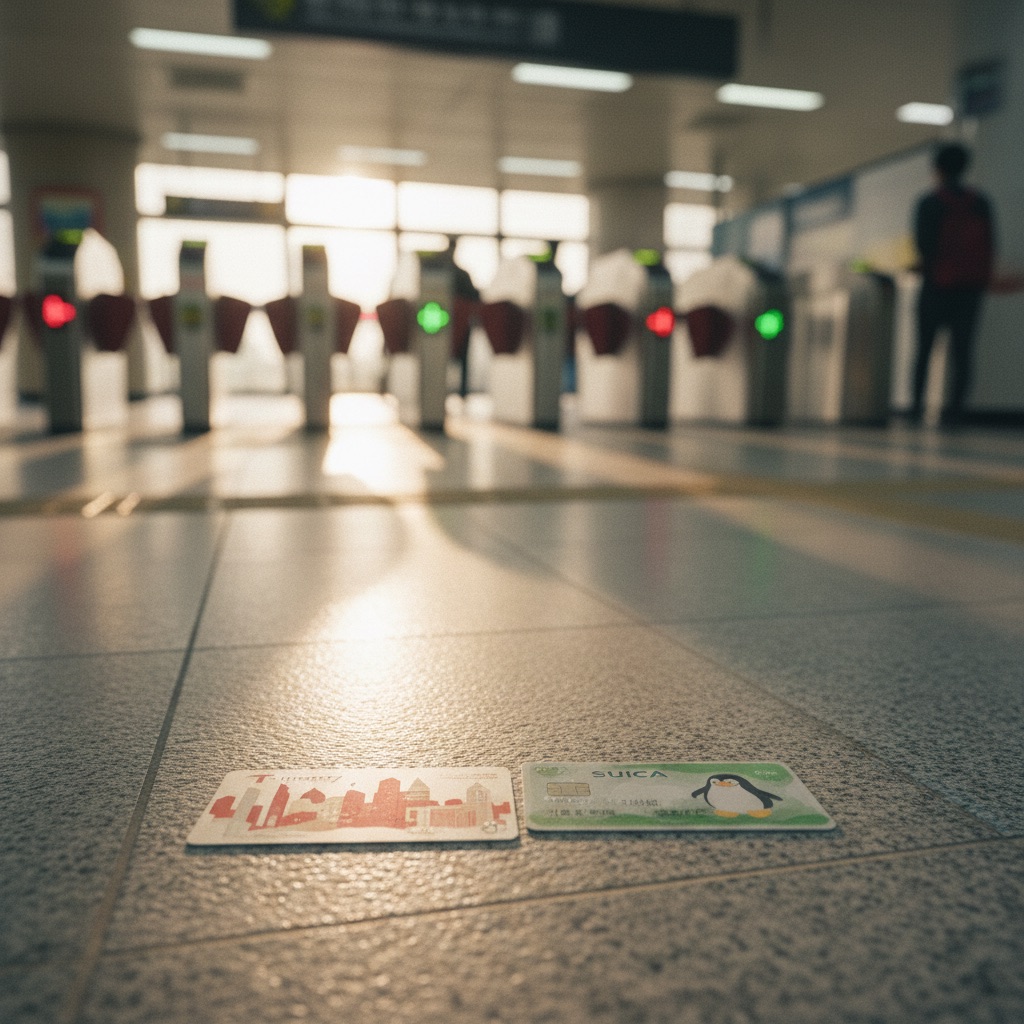
Two months in Seoul. Then a trip to Japan a few months later (Tokyo, Kyoto, Hakone).
Both countries have great public transport.
One of them has a transit card that, as a foreigner, is much smoother than the other.
Not the one most people would guess.
Quick version
- Japan’s Suica sits in your Apple Wallet. Tops up from the phone in seconds. Works on every train, bus, taxi and konbini nationwide.
- Korea’s T-money is, for most foreigners, still a physical plastic card.
- Topping up requires Korean won in cash, at a metro-station kiosk. Foreign cards work in some kiosks, not others.
- The paradox: the country with KakaoPay, Naver Pay and the most digital government in the OECD is behind on the one piece of infrastructure visitors use most.
The two experiences, side by side
In Tokyo: I land at Narita, walk to a JR ticket machine, scan an Apple Wallet Suica I’d already loaded with €30 from my phone before the flight, and I’m on the Narita Express within 20 minutes. Every subsequent metro ride, bus ride, taxi, konbini purchase: tap the phone. Top-ups happen automatically. I never think about the card again.
In Seoul: I land at Incheon, buy a plastic T-money card at the CU in the arrivals hall for ₩4,000 cash, walk to a top-up kiosk and load it with ₩30,000 of cash I just withdrew at a foreign-card-friendly ATM (with a €4 fee). Two weeks later I’m running late for a meeting, the card is empty, the kiosk at my station is broken, and I’m hunting for a 7-Eleven that accepts foreign card payment to top it up.
The difference adds up to maybe 15 minutes of friction per week over a long stay.
Not catastrophic. Just a real UX gap, and it contradicts the broader narrative.
Why the gap exists
The underlying technology is roughly the same. T-money and Suica are both FeliCa-family contactless cards. Both widely deployed. Both nationally interoperable.
The difference is who can carry them on a phone.
Suica on iPhone launched in October 2016. Apple, JR East and Sony co-engineered FeliCa support into the Japanese iPhone. The path from “I want a transit card on my phone” to “I have one” is: open Apple Wallet, tap Suica, load with any card. No Japanese phone number required. No bank account. Works for tourists.
Welcome Suica Mobile launched March 2025. A separate app explicitly for foreign visitors. Pre-load before arrival in Japan, top up in foreign currency, no Japanese SIM. The bar to entry is now effectively zero.
Mobile T-money on iPhone launched in 2023. But it requires either a Korean phone number or a Korean bank account. For a sub-90-day visitor, both paths are practically closed.
Mobile T-money on Android: easier in principle, also requires Korean verification, also closed to most foreigners.
The structural reason: Korea’s digital ecosystem is built on top of the real-name verification system that ties almost every consumer app to a verified Korean phone number. That’s also why KakaoPay, Naver Pay and KakaoBank are so smooth for Koreans - and so opaque to visitors.
The same architecture that makes daily life easy for residents makes infrastructure inaccessible to short-stay foreigners.
What this says about the broader Korea-vs-Japan story
The default internet take: Korea is ahead on digital, Japan is behind. KakaoTalk vs LINE. KakaoBank vs Japanese banking apps. Korean e-government vs Japanese paper forms.
Largely correct.
But the transit-card story is the opposite. For the specific subset of “I am a foreign visitor trying to use my phone for daily transport,” Japan is meaningfully ahead.
The reason:
- Korea optimised for residents. The digital ecosystem assumes you have a Korean phone number, bank account and ID. For residents, the result is dramatic convenience. For tourists, the same architecture is a closed door.
- Japan optimised for inbound. Suica and Welcome Suica Mobile are clearly designed for visitors - because Japan has, for decades, treated inbound tourism as a strategic industry. Korea’s tourism push is much newer; the infrastructure hasn’t caught up.
It’s a useful reminder that “digital lead” depends on whose convenience the system is built around.
The workarounds I figured out
If you’re going to Seoul for a few weeks or more:
- Buy the T-money card on arrival at any CU or GS25 in the arrivals hall. ₩4,000 for the card.
- Top up in larger amounts - ₩30,000-50,000 at a time - to reduce ATM-fee drag.
- Use a Wise card at the kiosks that accept foreign cards. Not all do. Most lines have at least one machine per major station.
- Bring physical KRW for the first 48 hours so you’re not hunting for ATMs on day one.
- If you stay 3+ months, open a Korean bank account. This unlocks mobile T-money and a thousand other things.
- Use KakaoTaxi for late-night travel. It accepts foreign credit cards.
What I’d want to see change
For Korea to match Japan on inbound transit convenience, the fix is technically simple. T-money would need a foreign-visitor flow that doesn’t require Korean phone verification - the way Welcome Suica Mobile does.
The technology is there. The willingness to relax the real-name-verification architecture for tourists is what’s missing.
I’d be surprised if it doesn’t arrive within the next 2-3 years.
FAQ
Can foreign visitors use Mobile T-money at all?
Not without significant friction. The verification paths typically require a Korean phone number or a Korean bank account. There’s no equivalent of Welcome Suica Mobile for visitors yet.
What about KakaoMap and Naver Map for transit?
Both work brilliantly for route planning. They don’t replace the card for payment - that’s a separate problem.
How much will the friction cost me over two weeks?
If you’re disciplined: very little - maybe 30 minutes of cumulative kiosk time and €15 in unnecessary fees. If you’re not: probably 2 hours of cumulative annoyance and €40 in fees.
Closing thoughts
The point of this isn’t that Korea is “behind.” It isn’t. The Kakao and Naver ecosystems do things no European digital infrastructure can match. KakaoBank account-opening in five minutes is UX Belgium will not see this decade.
The point is more specific: the architecture that makes Korean digital life so smooth for residents is the same architecture that closes the door on visitors.
“Korea ahead, Japan behind” is mostly true. The transit-card paradox is the exception worth knowing.