
Japan or South Korea: which to visit first?
I've been to both. Honest decision framework for first-time European travellers - cost, language, food, transport, and the kind of energy you want.
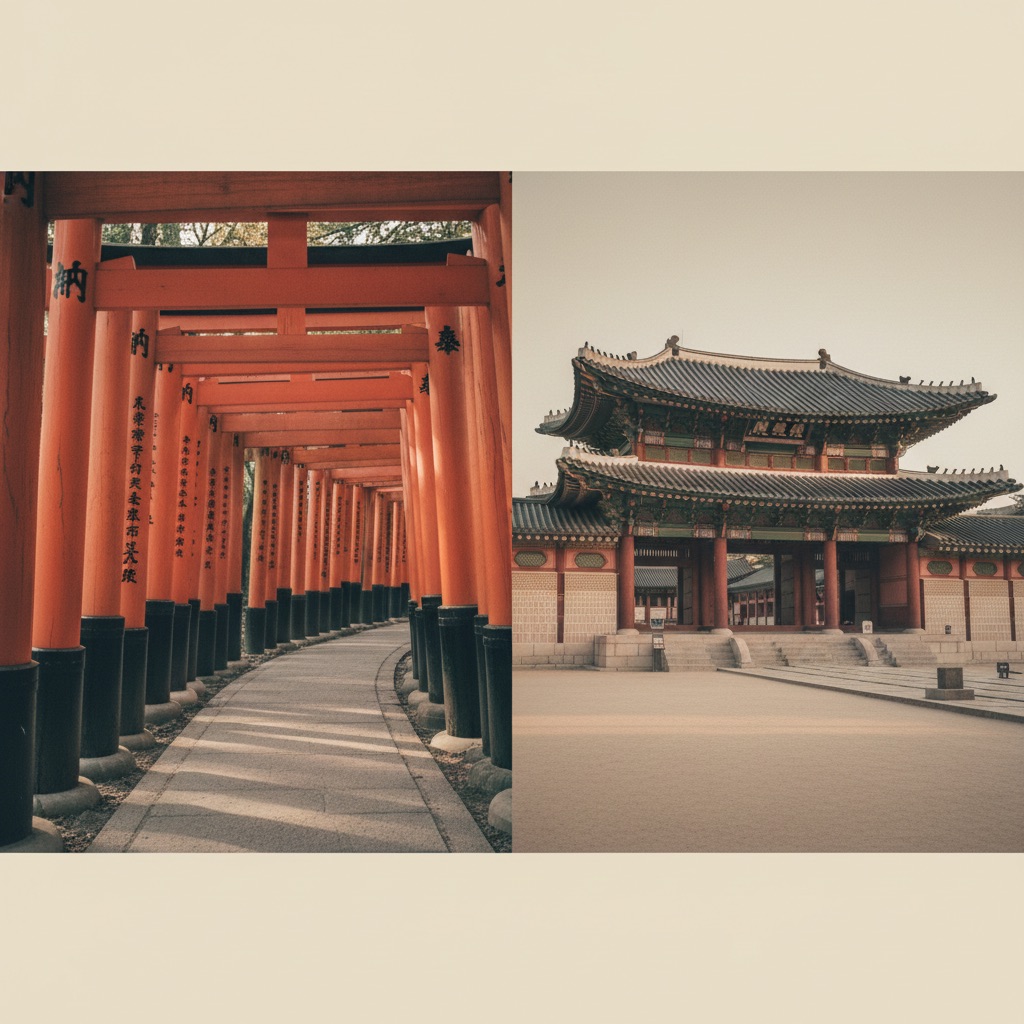
Every second person who finds out I’ve travelled to both Japan and South Korea asks the same question: if you only have one trip in you, which one first?
The official internet answer is “both, they’re different, you can’t compare.” True, and also unhelpful.
So this is the version I’d give a Belgian friend over dinner.
I went to Korea first (multiple trips, plus the recent two months working from Seoul) and Japan after (Tokyo, Kyoto, Hakone in May 2026). I’d give a different recommendation depending on what you’re after.
Quick answer
- Pick Japan first if you want depth and contemplation, careful design, structured travel, and predictable cost.
- Pick Korea first if you want speed and energy, faster food, less planning, more nightlife, and a culture that rewards spontaneity.
- Pick by season: April Japan (cherry blossom). October Korea (autumn colours, perfect weather). Avoid August in either - humid and exhausting.
- If you have 3 weeks and a normal budget, the right answer is to do both: Japan first, then five to seven days in Seoul. The contrast is the experience.
What each country is like, honestly
Both are East Asian democracies with ageing populations, high urbanisation, and world-class public transport. From any distance more than 200 kilometres they look similar.
From inside, they feel completely different.
Japan rewards slowness. The country is designed around small considered gestures - the way a coffee is placed in front of you, the way a temple garden is arranged, the way a packaging sticker is positioned. You go to Japan to notice things. Tokyo is loud only in specific places; the rest is contemplative. The food culture is precise. People are quiet, attentive, almost theatrically polite.
South Korea rewards energy. Seoul is the most digitally integrated city I’ve been in, and you can feel it in the pace. Food is faster, spicier, communal. People are more direct, warmer at the second meeting, more visible in public space. Drinking culture is robust. There’s a perceptible hustle that Japan doesn’t have.
Neither is “better.” They’re different temperaments.
Cost - honestly
Both are cheaper than Western Europe in 2026, with a different shape.
Japan is around 30% cheaper than Belgium for daily costs. A two-week mid-range trip from Brussels - decent hotel, JR Pass, eating at non-touristy restaurants - lands around €2,500-3,500 per person. Big-ticket costs (Shinkansen, premium ryokan) are expensive. Day-to-day costs (konbini food, set lunches, metro) are cheap.
South Korea is around 40% cheaper than Belgium for daily costs. Two-week trip with flights, hotel, KTX and good food sits closer to €2,000-2,800 per person. Food in particular is dramatically cheap - €5 buys you a proper Korean meal almost anywhere.
Both countries: you can travel much cheaper by staying in capsule hotels (Japan) or guesthouses (Korea), or much more expensively by booking ryokan and 5-star hotels.
Language and getting around
Both rank in the easiest tier of East Asian destinations for an English-speaking European, for different reasons.
Japan has better signage. Train stations, museums and major commercial districts are fully in English. Spoken English level outside hospitality is low. You’ll communicate with gestures, Google Translate camera, and three words of Japanese. Train ticket machines, restaurant menus, hotel check-in - all systematically translated.
Korea has slightly better spoken English in tourist areas - Korean students learn English seriously and are more confident using it. Signage is reasonable but less consistent than Japan. The major saving grace: Hangul, the Korean alphabet, can be learned by a curious traveller in three hours. Once you can sound out signs, the country opens up.
For an absolute beginner who’s nervous about navigation: Japan wins by a small margin. For someone who’s confident with Google Maps and isn’t afraid to ask a passing student for directions: Korea is fine.
Food - the most important section for most people
Food is where they diverge most.
Japan rewards specialisation. The best ramen shop in Tokyo only serves ramen. The best tempura place only serves tempura. The chef has been doing this for thirty years and the menu has not changed in twenty. Flavour profile is umami-forward - dashi, soy, miso, fresh fish. Spice is rare. Portions are calibrated. A great Japanese meal feels like a careful conversation.
Korea rewards generosity. Every meal arrives with eight to fifteen banchan on the table, free, refillable. The main dish is shared in the middle. Flavour profile is bold - gochujang, kimchi, garlic, sesame, charcoal. Spice is everywhere. Communal eating. A great Korean meal feels like a friendly argument.
If you live to eat: do both. But Japan first if you tend toward precision. Korea first if you tend toward abundance.
One specific note: vegetarians and vegans have a markedly easier time in Korea than Japan. Korean Buddhist cuisine is fully plant-based and widely available. Japanese dashi is in everything that looks vegetarian and rarely advertised.
Transport - both world-class
Both countries have public transport that European visitors will find quietly magical.
Japan’s system is famously punctual, calm and fully integrated. The Shinkansen connects every major city at 250+ km/h. The JR Pass, available only to foreign visitors, lets you ride almost all of it for a fixed weekly cost. Local metros and buses are equally well-run. One IC card (Suica or Pasmo) for everything.
South Korea’s KTX is just as fast and arguably more comfortable. Seoul’s metro is the most extensive in the world and runs until midnight. The T-money card works on everything including taxis.
For a two-week trip: Japan with a JR Pass is the path of least resistance. For a Korea trip you don’t need a pass - tap into the system and pay as you go.
The exception worth knowing: Korea’s T-money is much less foreigner-friendly than Japan’s Suica on iPhone. More on that paradox here.
The “wow” moment
Every visitor has a moment in their first 48 hours when the country clicks. They’re different.
In Japan, the wow moment is almost always small. It’s noticing that the taxi driver wears white gloves. It’s finding the hotel slippers fit perfectly. It’s a stranger walking with you for three blocks because the directions were complicated.
The country reveals itself in details.
In South Korea, the wow moment is usually bigger. It’s the first night out in Hongdae with five Koreans you met an hour ago. It’s the scale of Coex Mall. It’s standing on Cheonggyecheon at dusk and realising this restored stream runs through downtown Seoul like a quiet ribbon of city design.
The country reveals itself in moments.
If you tend to remember details from trips: Japan. If you tend to remember moments: Korea.
When you should NOT go to each (yet)
Don’t go to Japan first if: you dislike planning, you hate queues, you want lots of nightlife (Tokyo nightlife is good but compressed), you have severe food allergies (fish and soy are everywhere and unmarked), you can’t handle very crowded trains in summer, or you specifically want a country where strangers are warm on first contact.
Don’t go to Korea first if: you dislike spicy food (it’s hard to escape), you have a low tolerance for crowds (Seoul is denser and noisier than Tokyo), you want very high-end hotel experiences (Japan has more polish at the top), you’re sensitive to drinking culture (it’s everywhere socially), or you want a quiet, slow-paced visit.
The recommendation framework
Three questions.
- How do you travel? Planner with itinerary → Japan. Adaptable, prefer to wander → Korea.
- What do you want to feel? Calm, considered, observed → Japan. Energised, in the middle of things → Korea.
- What food do you love? Precise, single-ingredient focused → Japan. Communal, bold, generous → Korea.
If you answered Japan to two or three, go to Japan first.
If you answered Korea to two or three, go to Korea first.
If you answered mixed, go to Japan first - the structure and signage make it the more forgiving introduction to East Asia, and Korea will hit harder when you arrive there afterwards already calibrated.
What surprised me as a Belgian
I expected Japan to feel further from Brussels than Korea. The reverse was true.
Tokyo, with its 19th-century European-style train system, its formal restraint, its quiet streets, felt structurally familiar in a way Seoul did not.
Seoul, with its rapid casual social style, its hustle, its constant adaptation, felt more foreign - and also, on day three, more welcoming.
Japan looks further but feels closer. Korea looks closer but feels further.
Both are wonderful. Knowing which kind of distance you find energising will tell you which to do first.
Practical thoughts
- If you have only one trip: Japan first for most people. Korea first for energetic urbanists.
- If you have a 3-week window: Japan (10-14 days) then Korea (5-7 days in Seoul). The contrast is the trip.
- April and October are the right months. Avoid August everywhere.
- Book the JR Pass before you arrive in Japan. You don’t need a pass in Korea.
- Budget €2,500-3,500 for Japan, €2,000-2,800 for Korea, per person, ex-Brussels, two weeks, mid-range.
FAQ
Can I do both countries in one trip?
Yes, and it’s the most popular combined itinerary in Asia. 10-14 days Japan + 5-7 days Korea works well. Cheap one-hour flights between Fukuoka and Busan, or Tokyo/Osaka and Seoul.
Which has better food?
Wrong question. Different food. Japan has more precise food at the high end. Korea has better everyday street food and more generous portions everywhere.
Should I learn the language?
No, but learn three words in each: sumimasen / arigatō / onegaishimasu for Japan; annyeonghaseyo / kamsahamnida / juseyo for Korea. Hangul is genuinely learnable in a few hours and worth doing.
Closing thoughts
The “Japan or Korea” question has been asked a million times because it doesn’t have a clean answer.
They’re both at the top of the global ranking for first-time East Asian travel. Different temperaments. Similar quality.
For most Europeans, especially those who like structure and detail, Japan is the gentler introduction.
For Europeans who already know they like dense cities, late nights and bold flavours, Korea is the more rewarding first stop.
Whichever you pick, the other one is waiting. And it’s almost always a good idea to come back.