
First two weeks in Gangnam-Seocho: what surprised me about living in Seoul
After two weeks living in Gangnam-Seocho, Seoul already feels different from a short trip. Here's what surprised me about the neighborhood, cafés, food, Korean classes, and daily life.
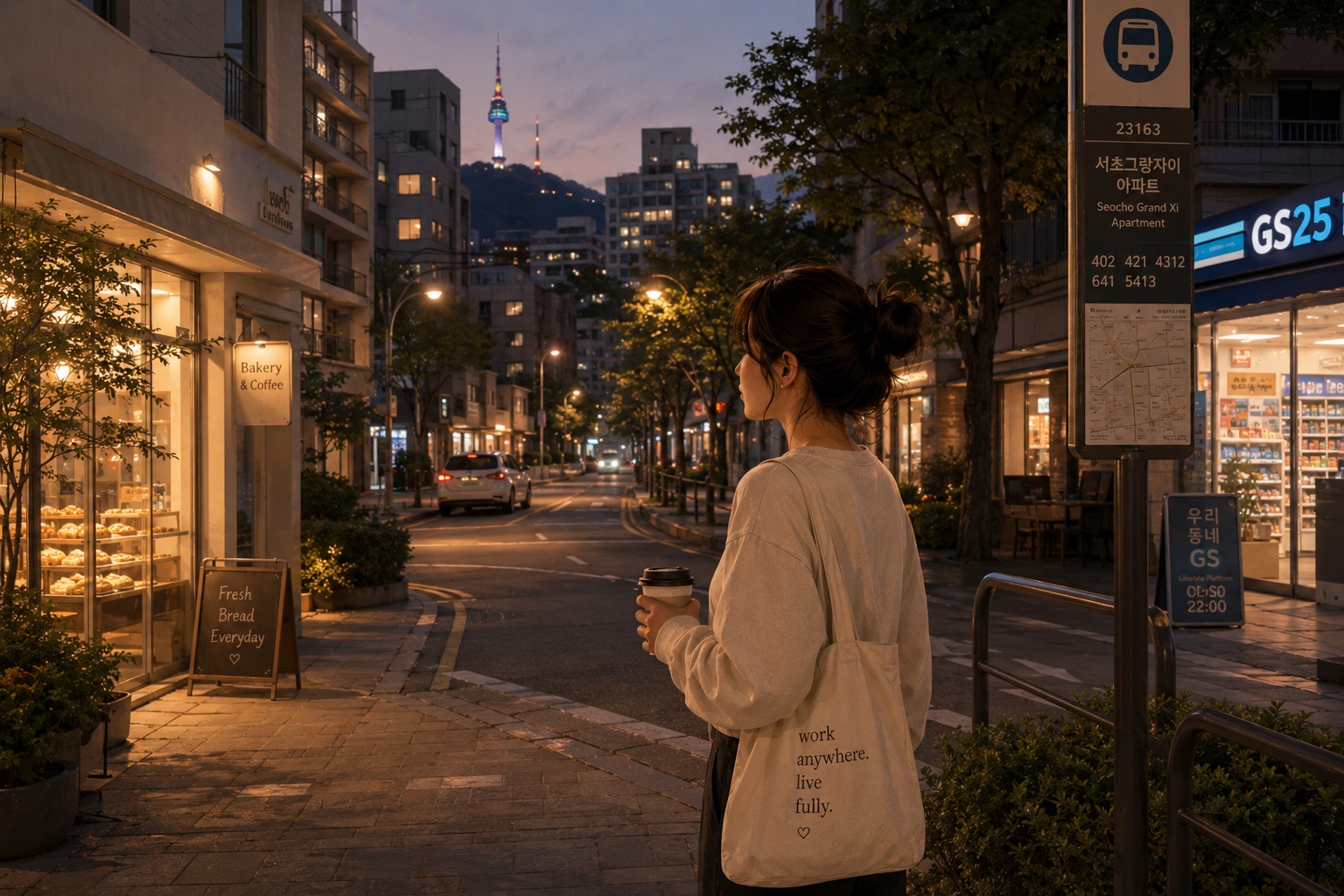
I've been in Seoul for two weeks now.
The hotel where I'm staying in Gangnam-Seocho is small. By day three I already knew where every plug is.
Korean class at EF has a rhythm. Work is busy - Q4 means new projects starting, lots of decisions to make, late client calls.
And I'm slowly noticing the difference between visiting a city and actually living in one.
That's a bigger difference than I thought.
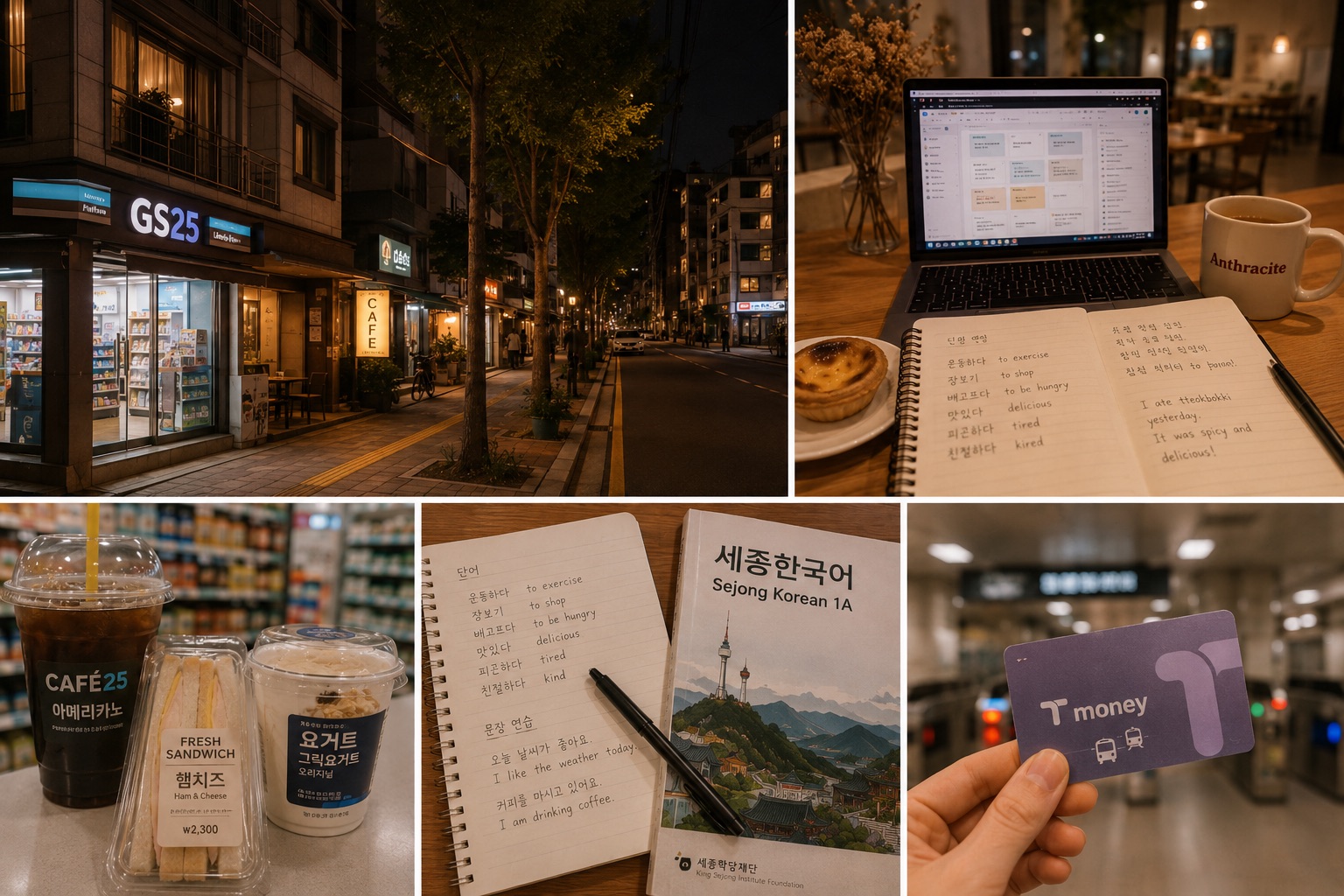
Quick version
- Gangnam-Seocho is not what foreigners imagine. The nightlife stereotype is one small area. The rest is quiet, residential, families.
- Supermarkets around here are very small. I planned to eat out anyway, so I didn't try to find bigger ones.
- 24/7 restaurants nearby. A lot of them. It's the thing I didn't expect that changed my whole rhythm.
- Working from cafes really works here. It's the default mode for Korean freelancers, and you feel it.
- EF is helping me meet people more than I expected. The social side has been a real bright spot.
- One unexpected frustration: the public transport card. I'll write a separate post about it.
The neighborhood
Most foreigners know Gangnam-Seocho because of Gangnam Station. That part is loud, neon, and clearly built for tourists.
The rest of the district is something else.
Five minutes south of the main commercial street, you're in a residential grid. Small apartment buildings. Side-street cafes. A dry cleaner. A stationery shop. A butcher. Two small grocery stores. A hagwon for kids on the corner.
Teenagers in school uniforms walking home late afternoon. Couples with strollers. Older men playing a board game in a small park - I still don't know which game.
It's quiet. I didn't expect that for a "central Seoul" address.
My building has a 7-Eleven on the ground floor. A bakery two doors down. A bus stop right outside. The metro is about ten minutes away on foot.
I walk back at 1am after late client calls. And honestly, I don't think about it. That's the part of Seoul I keep noticing.
Food: I came planning to eat out, and that worked
The idea I arrived with was simple: Korean food is cheap, restaurants are everywhere, I'll eat out.
That's exactly how it's been.
A proper Korean lunch - bibimbap, kimchi jjigae, side dishes - costs around 8,000 to 12,000 KRW (€5.50-8). Cold noodles at the local kalguksu place are 9,000 KRW. A coffee next to the hotel is 4,500 KRW.
In Brussels, these prices would be double. And the food wouldn't be as good.
The supermarkets around me are very small. Different from a European mid-size supermarket: more compact, more focused on basics. I didn't try to find bigger ones because I was going to eat out anyway.
For me, that worked out perfectly.
The thing I didn't expect: 24/7 restaurants
This one surprised me the most.
Within walking distance of the hotel, there are many restaurants open 24/7. Real restaurants. Not just convenience stores.
You finish a client call at 2am, you can still sit down and have proper food.
I knew Seoul stayed open late. I didn't realise it stayed open that late, with real options.
For someone who often ends work between 2 and 4am, this changes how the day feels.
It sounds small. But it's the difference between "I worked until 3am and there's nothing left" and "I worked until 3am and I can go eat real food before I sleep". Honestly, that's a real difference.
Working from cafes
The cafe-as-office culture in Seoul is real. Abundant. And surprisingly good.
Most cafes in Gangnam-Seocho have:
- Plugs at most tables
- Wi-Fi that works
- An unspoken tolerance for three hours with one Americano
- Background noise low enough to take a call
- Hours that fit both early risers and late finishers
I split my week between a small coworking space (one day, when I need a proper video setup) and three different cafes within walking distance.
Variety, but also a bit social. The staff at the second one already know what I order.
In Brussels, doing the same setup takes more effort. Which cafes tolerate laptops? Where is the Wi-Fi good? Are the chairs comfortable for four hours?
In Seoul, the default is just yes. For me, that makes a real difference when I have to work long hours.
EF and the people side
I signed up for the morning Korean program partly to learn, partly to meet people.
The people side has been the surprise.
The school has a mix of digital nomads, exchange students, mid-career people on a sabbatical, and a few Koreans returning after time abroad. The lunches and after-class coffees produced a small group I'm now in Seoul with.
That's been really nice. I wasn't sure what to expect from a class full of strangers, and it turned out to be one of the warmer parts of the trip so far.
I'll write a proper review of the school in November once the course is done. The honest version is a different post.
The frustration I didn't expect
The thing that's bothered me most in two weeks is small. And it's the transport card.
In Japan, I'm used to putting the Suica card on the iPhone Wallet. Top up from the phone. Tap in and out.
In Korea, the T-money card is still a physical plastic thing.
To top it up, I need cash, in Korean won, at a metro station machine. As a foreigner without a Korean bank account or phone number, the mobile T-money paths are basically closed.
It's a small thing. It's also extremely annoying when you're running late and need to find an ATM that takes a foreign card to withdraw cash to top up a card to ride one metro stop.
I'll write a whole post about this because the contrast with Japan is one of the genuinely surprising things I've noticed.
What I was wrong about
Two things, after two weeks.
I was wrong about Hangul.
Being able to sound out signs is helpful for the first thirty seconds of any interaction. After that, it's not enough.
The actual conversation still needs either Korean fluency I don't have, or English the other side may or may not.
The Hangul-reading goodwill is real. But it's limited.
I was wrong about the food.
I thought eight weeks of Korean food might wear on me. Two weeks in, the opposite is happening.
I keep finding regional and category lanes I hadn't really known existed. The kalguksu place. The dakhanmari place. The kimbap counter. The bunsik joint. The small specialised seafood stall.
Each one is its own world. I'm not bored. I don't think I will be.
Practical thoughts
- If you're staying more than two weeks: get accommodation in a residential pocket of a "famous" district, not on the famous district's main strip. Gangnam-Seocho side streets are quieter and a fraction cheaper than the equivalent in Itaewon or Hannam.
- If you don't want to cook: you really don't have to here. Restaurants are good, cheap, and a lot of them stay open very late.
- Pick three cafes to rotate. One quiet, one with good food, one near the metro. You'll need each in different moods.
- Bring cash for the transit card. Or accept that the first week will include ATM detours.
- If you're doing Korean for two months, do it through a school. Not just for the language - the structure and the small social network it gives you are a real part of the value.
FAQ
Is Gangnam-Seocho a good area to stay in Seoul?
Yes, I think Gangnam-Seocho is a good area if you want to be well connected but not always in the middle of the busiest streets. Some parts of Gangnam are very intense, but where I’m staying, it feels more residential, calm, and easy to live in day to day.
Is it easy to work from cafés in Seoul?
Yes, working from cafés in Seoul has been very easy so far. Many cafés have Wi-Fi, plugs, and enough space to sit with a laptop. Compared to Belgium, I feel less awkward staying for a few hours to work.
What surprised me most after two weeks in Seoul?
What surprised me most is how quickly I started building a routine. I expected Seoul to feel exciting but maybe a bit overwhelming. Instead, daily life in Gangnam-Seocho feels calmer than I thought, with small routines around cafés, Korean classes, convenience stores, and work.
Closing thoughts
Two weeks isn't long.
But it's long enough to break the assumptions that two previous visits had quietly built up.
The mental model I arrived with: I know Seoul.
The mental model I'm leaving week two with: I know what tourists see. And I'm starting to see something else underneath it.
The neighborhood is quieter than the brochure. The 24/7 restaurants are better than I thought possible. The transit card is more annoying than I expected. The cafes are better than they need to be.
And the people side of being here has been really nice. I'm enjoying this more than I thought I would.
That's also part of the experience.