
EF International School in Seoul: my honest review as a working freelancer
I spent six weeks at EF in Seoul while working full-time. Honest take on what worked, what didn't, who it's for, and what I'd do differently next time.
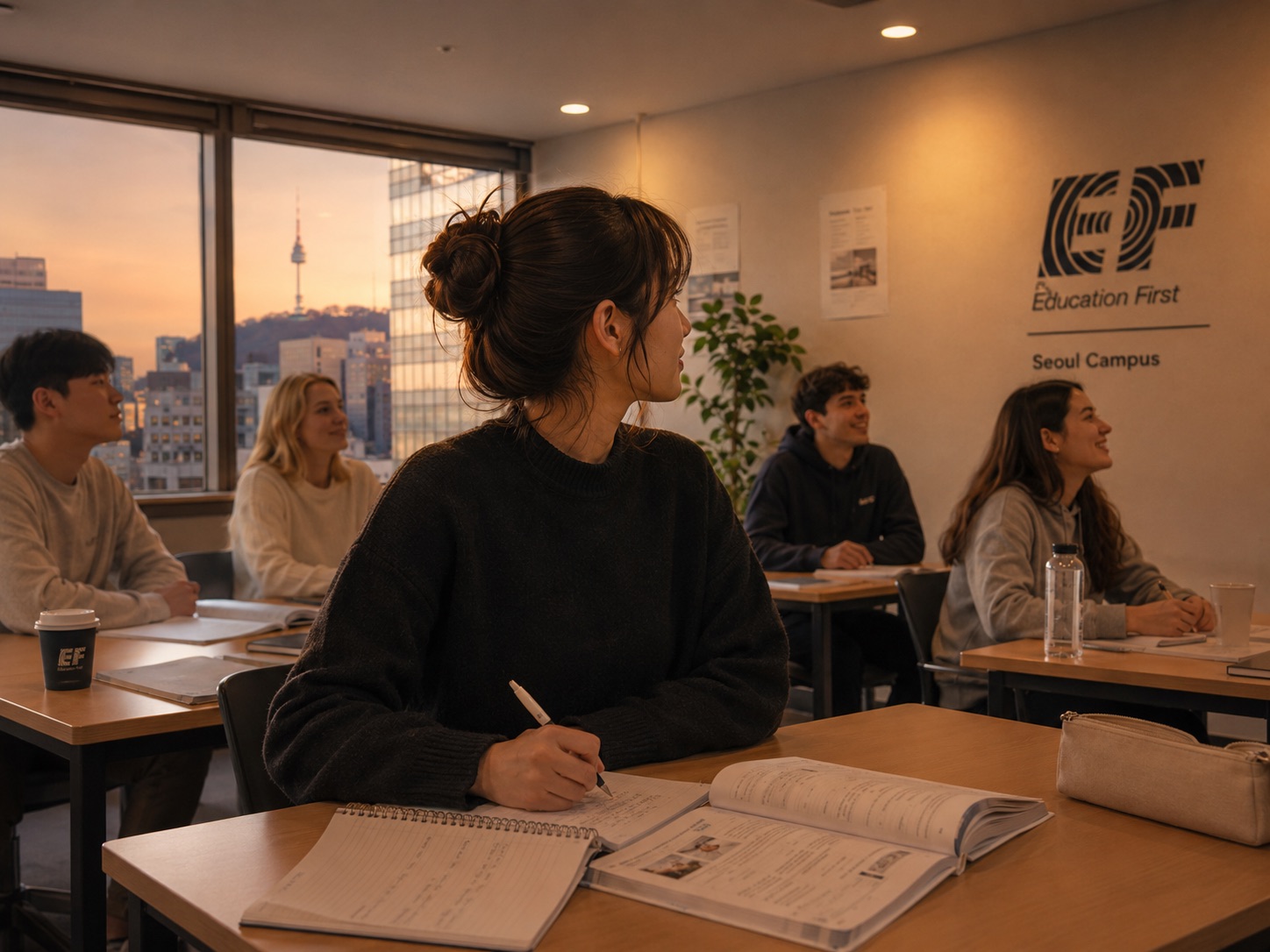
I went to Seoul for two months mostly to work.
But I also wanted to test something: I’m a marketer, I’m interested in the Korean market, and I wanted to see if two months on the ground could open up Korean projects or conversations. Plus, I wanted to learn the language - both because I love it, and because I knew real Korean would be the unlock for proper local relationships.
EF International School was the program I picked for the language side. Six weeks of morning Korean classes on top of my normal client work.
The teachers were good. The other students were lovely. The hotel was actually a bright spot.
And still, for someone like me, the fit wasn’t quite right. Here’s the long version of why.
Quick version
- Why I went: test work + Korean fluency + meeting Korean marketers, all in one trip.
- What I got on the marketing side: real outcomes (two new project leads, working marketer network), but through other foreigners in Seoul, not through Koreans.
- What I got on the language side: Hangul fluency, basic sentences, not even numbers reliably. Useful, not transformative.
- What I know now: real Korean takes six months full-time. The local network needs industry rooms (meetups, conferences, KakaoTalk groups), not a language school.
- What worked at EF: the teachers, the hotel, the social side with other students.
- What didn’t work for me: a cohort built mostly for full-day learners (retirees, exchange students). Not many working professionals.
- The fair framing: everyone else in my class seemed happy. EF is doing its job for the people it’s built for. I just wasn’t quite in that target.
What I was actually trying to test
The decision to go to Seoul for two months wasn’t “I want to learn Korean.” Korean was a means to an end - and the end was professional.
I work in digital marketing. Korea is one of the most interesting markets in the world: a different platform ecosystem (Naver, Kakao, Coupang), a much more mobile-first consumer, a unique influencer-and-creator economy. I wrote about some of this in the Google Ads in Asia piece.
The professional question was simple: could two months on the ground put me in front of Korean marketers and foreigners-with-Korean-clients?
The language was the next step. Without functional Korean, the local scene stays closed. I knew that going in.
So the combined test: can I run my normal freelance business, learn Korean meaningfully, and meet working professionals who could lead to future Korean projects? All in one trip.
EF advertised exactly the schedule I needed: morning-only classes, freedom to work the rest of the day, an international cohort.
What six weeks actually got me, language-wise
I stayed for six weeks of morning classes within a roughly seven-week working trip.
By the end I could:
- Read Hangul fluently (most of that I’d done on the plane)
- Construct simple polite-form sentences in present tense
- Handle basic shop interactions if the other party slowed down
- Recognise common written words on signs and menus
What I hadn’t learned:
- Numbers reliably (Korean has two parallel number systems and you need both)
- Past tense or future tense beyond a single chapter
- Anything I’d call “useful for Korean professional life”
- Real conversation with a Korean speaker on any topic
For comparison: I spent six months in New York in my twenties. By the end I was functionally fluent in English. Six weeks of Korean got me roughly the equivalent of two weeks of English in New York.
The math is brutal. Real Korean fluency takes around six months of full-time learning. And that’s incompatible with running my freelance business.
No program could have shortened that math. It’s not EF’s fault.
The cohort - and why it wasn’t built for my situation
The cohort at EF Seoul in autumn 2025 broke roughly into three groups:
- Retired or semi-retired adults learning Korean because they could afford to and they wanted to
- Younger students - exchange students, gap-year travellers, recent graduates - many K-pop or K-drama motivated
- A small contingent of working professionals. I counted maybe three of us across six weeks who were running full-time work alongside the course.
Everyone in my class seemed happy. The pacing fit the dominant groups. The school clearly delivers on what most of the cohort wants.
My situation - working full-time on US hours, needing afternoon and evening for clients, wanting practical Korean as a path to a local professional network - was just a minority within the room.
The cost mattered. For €6,000+ all-in (school plus accommodation), I came in with high expectations. A 22-year-old gap-year student probably has different ones. Different buyers, different expectations.
The marketing side - what actually happened
This is the part of the trip that surprised me most.
I went hoping that two months on the ground - plus the school cohort - would put me in front of Korean marketers in a way that could lead to future work.
Some of that did happen. I met working marketers, ran some genuinely useful conversations, came back from Seoul with two project leads that materialised in the months that followed.
Those projects weren’t with Korean people, though.
They came through other foreigners in Seoul - international marketers at coworking spaces, the small working-professional group from my EF class, expat networks through LinkedIn and Slack.
The Korean local marketing scene didn’t open up to me. Without functional Korean and without the right industry introductions, that scene stays closed.
EF didn’t help with this. And honestly, it couldn’t have.
The cohort was almost entirely international students learning Korean. The Koreans I needed to meet weren’t in the school - they were at industry meetups, in KakaoTalk professional groups, at marketing conferences like DigiPro Korea, in the offices of Korean ad agencies.
The school can give you the language. It can’t give you the local network. Two different problems, two different toolkits.
Two specific things I’d flag for working professionals
Morning-only classes weren’t always strictly morning-only. I had been told repeatedly during the sales conversations that I could take morning classes only. In practice, the scheduling didn’t always work that way. Some sessions I’d have liked to take were in the afternoon. I couldn’t make them because of client calls.
The hotel was further from the school than I’d been told. The hotel itself was very nice - more on that below. But the journey to class was around 30 minutes by metro on a good day. And 3pm class end meant a sprint to a 4pm client call right as Seoul hits afternoon traffic. The proximity claim was generous.
The hotel - actually a bright spot
I want to be specific about this one because it would be unfair not to.
The EF-arranged hotel was a nice place. Looking at what I would have paid for an equivalent single hotel room booked separately in central Seoul, the EF rate was actually cheaper.
And the package came with two things I genuinely valued:
- An EF representative on-site at the hotel who could help with the small administrative things short-stay foreigners get stuck on - SIM cards, banking, lost-key situations, late-night questions.
- Cleaning every two days, which is more generous than most hotels I’d booked in Seoul or Tokyo at this price tier.
After a string of long work nights, walking into a freshly-cleaned room is its own quiet luxury.
The honest summary: the hotel was a good piece of the package. I just wish it had been closer to the school.
The small logistics
- Each class was 1h40. That’s a long block for serious language drilling. Attention drops after about an hour.
- 30 minutes between classes. Class 1 ended at 11:50, Class 2 started at 12:20. Convenience-store density immediately around the school wasn’t great. Lunchtime queues were long. We came back to Class 2 with three bites of gimbap still in our hand - and the policy was no eating in the classroom.
- Few bathrooms relative to the number of students. Small friction, real over six weeks.
- The optional add-on classes (vocabulary, pronunciation) were the best part of my week. I’d take vocabulary again.
What was genuinely good
- The teachers. Patient, structured, kind.
- The other students. Genuinely nice people, including the retirees and the younger crowd.
- The hotel and on-site EF support. Good value, with extras I couldn’t easily replicate solo.
- The structure of being somewhere by 9am. Morning rhythm forced me out of the apartment - I needed that.
- The optional vocabulary class.
The cost - and the math behind it
EF program plus the single hotel room came to just over €6,400 over six weeks.
I chose the single room specifically because I needed private space for client calls. Dorm or twin options were cheaper but unworkable. Host-family placements were even cheaper but came with their own issues - I heard students complain about 90-minute commutes to class. That wouldn’t have fit my afternoon schedule.
The single hotel room was the right call.
For a working professional in my situation, the €6,400 is significant. For the cohort the school is built for - retirees on a hobby, students with structured time - the same amount probably feels proportionate.
What I’d do differently next time
If I had the same combined goal again, I’d structure the trip differently.
On the language side:
- A one-on-one Korean tutor for 60-90 minutes a day, 5 days a week, scheduled around my client calls.
- A structured app (Memrise, Anki, Renshuu) for daily practice between sessions.
- Korean conversation partners via Tandem or HelloTalk.
On the marketing-network side:
- A coworking space in Gangnam or Yeonnam from day one. The international marketing crowd is there.
- One marketing event per week - DigiPro, Korea Brand Marketing Summit, ad-tech meetups.
- Pre-trip LinkedIn outreach to Korean-American or returnee marketers in Seoul.
- An introduction to one Korean industry KakaoTalk group.
None of this is criticism of EF. It’s just that language, work and local network are three separate problems. The single program that solves all three doesn’t exist.
Who EF Seoul is right for
- Gap-year students, exchange students, recent graduates with structured time. The cohort is built for you.
- Retired or semi-retired adults learning Korean as a serious hobby. The pacing works.
- Working professionals, but with the right expectations: you’re paying for structured language progress and an international social network. Not Korean local relationships.
Who I’d think twice about:
- Anyone counting on the school to deliver Korean local network - it structurally won’t.
- Anyone on a tight budget who specifically needs maximum language progress per euro. Korean university programs (Sogang, Yonsei) are cheaper.
- Anyone going for less than three weeks. The cohort dynamic doesn’t form. The language progress is marginal.
What this trip actually answered for me
I love Korea. I want to live in Korea eventually, in some form.
The honest version of “could I run my business, learn the language and build a Korean marketing network all in one trip?” turned out to be: not all three at once, not at the level I’d want.
What I did get: a clearer view of what each part actually requires.
- Real Korean fluency: six months full-time, minimum. Not compatible with freelance work in parallel.
- Korean local marketing network: industry rooms, not language schools. And functional Korean to land.
- Freelance work from Seoul: entirely doable, more pleasant than Brussels for the kind of hours I keep.
- Foreigner marketing network in Seoul: easier than I expected. Two project leads came from that.
The most useful thing I took home: language, work, and local network are three separate problems. Treating them as one bundle was the assumption that needed updating.
Practical thoughts
- If you’re a working professional considering EF Seoul, ask how many of the current cohort are working full-time.
- If your day has hard client call commitments, verify the journey time from the EF hotel to the school at actual peak hours.
- Six weeks gets you to “reads Hangul, says basic things in restaurants.” Plan accordingly.
- If your goal is conversational fluency, plan for six months full-time.
- The EF-bundled hotel is good value. Don’t dismiss it.
- Treat language, work and local network as three problems. The single program that solves all three doesn’t exist.
FAQ
Was EF International School worth the cost?
For language alone, no - the Korean university programs (Sogang, Yonsei) are cheaper and academically denser. For language plus social structure plus a friend group of international students, yes. For language plus building a Korean local network, no - that needs a different toolkit.
How much Korean can I learn in six weeks?
Realistically: Hangul reading, basic polite-form sentences in present tense, basic shop interactions. Not numbers reliably, not past tense, not real conversation.
Would you go back to EF Seoul?
For the same combined goal as this trip, no. For a slower sabbatical version with no client work, maybe. For the social experience and the hotel comfort, yes.
Closing thoughts
The teachers were good. The hotel was a bright spot. The cohort around me was happy.
And for someone in my exact situation - working professional hoping the school would also be a path to Korean local network - the fit wasn’t quite right. That’s a real outcome, but not the one I’d hoped for.
If you’re considering EF from a similar angle, plan three problems with three strategies. EF is a fine tool for one of them.