
Why convenience stores in Japan and Korea are so much better
Fresh meals, bill payment, parcel pickup, ATMs that work. Japanese and Korean convenience stores are public infrastructure dressed as retail. Here's why.
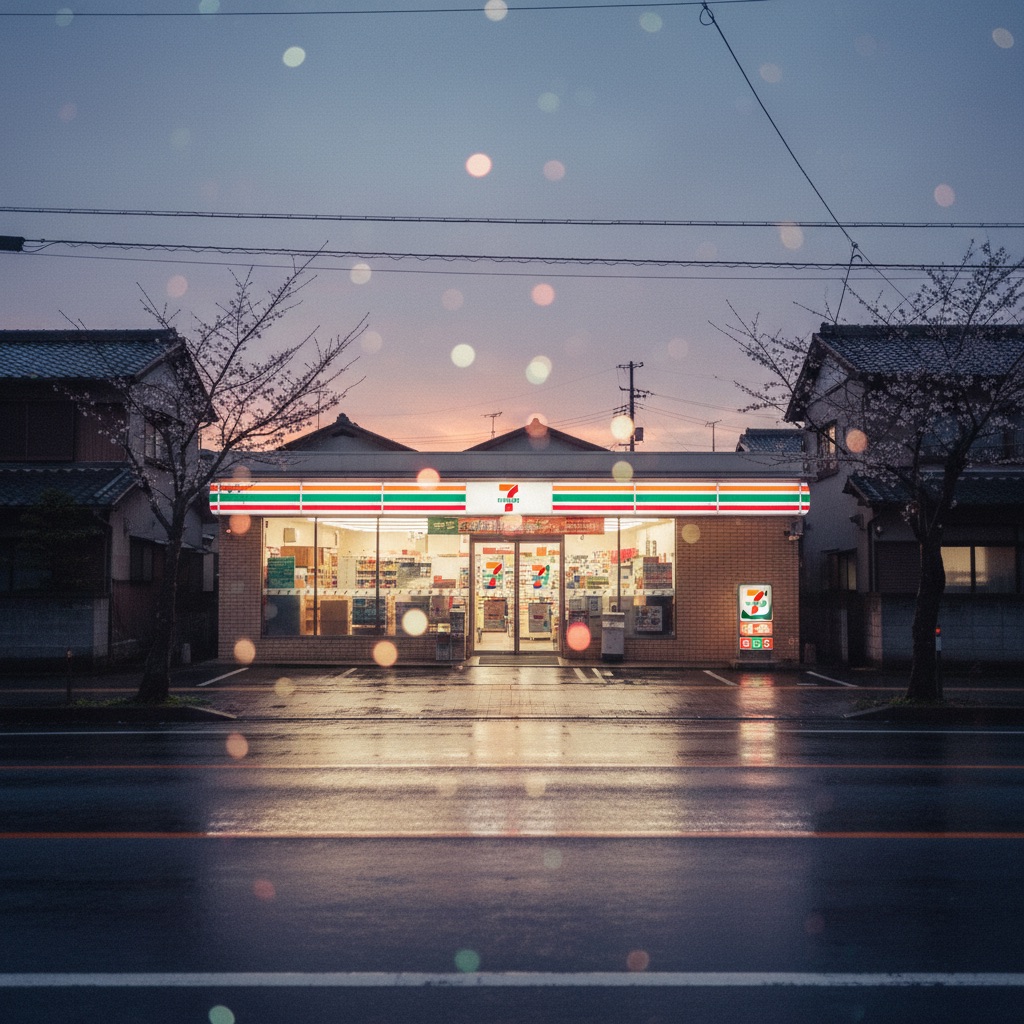
The first time I really used a 7-Eleven in Tokyo, I left with a freshly-steamed pork bun, a chilled green tea, ¥10,000 I’d just withdrawn from the ATM, and a slightly confused look.
The shop had also accepted a parcel I needed to send, sold concert tickets at a kiosk, and printed something for the people in front of me.
It was midnight. The place was busy.
I came home and walked into a Carrefour Express in Brussels three days later.
It’s genuinely a different kind of shop.
Quick version
- Japanese and Korean convenience stores - konbini in Japan, 편의점 in Korea - aren’t corner shops. They’re infrastructure.
- Three things make them work: density, vertical supply chains, and a licence to do things European corner shops can’t (pay bills, accept parcels, dispense cash from any bank).
- European convenience formats have made the opposite structural choices.
- Korea’s version leans into hangout - tables, eat-in, cheap ramyeon at midnight. Japan’s leans into precision.
The European mental model that breaks fast
A Brussels convenience store is a small petrol-station-style shop selling overpriced snacks and dusty pasta. You go because you need something at 10pm and you’ve made peace with the fact that it’ll be mediocre.
That model is so embedded I had to physically unlearn it.
The first time a Tokyo konbini sandwich was objectively better than what I’d buy from a Brussels bakery at lunchtime, I sat on a curb and thought about it.
The shift to make: konbini aren’t corner shops. They’re distributed micro-supermarkets that also do post-office, banking and utility tasks.
That’s a different category of thing. It’s why the comparison feels unfair.
What a Japanese konbini actually does
The food gets the headlines.
A Lawson, 7-Eleven or FamilyMart in central Tokyo reliably stocks:
- Freshly-made onigiri (rice balls) delivered up to three times a day, dated to the hour
- Cold sandwiches with real fillings - egg, ham-and-cheese, tuna, fruit-and-cream
- Hot food behind the counter: fried chicken (Lawson’s Karaage-kun, FamilyMart’s Famichiki), steamed buns, oden in winter
- Bento boxes warmed in-store, properly cooked, often under €5
- Decent drip coffee for around €0.70 (at 7-Eleven; Lawson and FamilyMart run a bit higher)
- An aisle of regional and seasonal snacks that rotates every two weeks
Then there’s the part Europeans rarely realise is even possible:
- Bill payment: walk in with a gas bill or tax invoice, scan the barcode, pay in cash or card.
- Parcel pickup and drop-off: order from Amazon Japan or Rakuten to a 7-Eleven and collect.
- ATM access: 7-Eleven’s own ATM network accepts virtually every international card with honest exchange rates.
- Tickets: concerts, baseball games, Ghibli Museum reservations printed at the multi-function kiosks (Loppi at Lawson).
- Document printing, copying, faxing - including official government forms.
- Free Wi-Fi, clean public toilets, a small dining counter by the window for the bento you just bought.
Korea’s version leans into hangout
Korean convenience stores - CU, GS25, 7-Eleven, Emart24 - do almost everything Japanese ones do, plus one thing that surprised me: they’re a legitimate social space.
Many GS25 and CU branches in Seoul have a proper eat-in area with plastic tables. Sometimes outside under a parasol. Students sit there in the evening with a cup of ramyeon (the store provides hot water), a beer, and the homework they were meant to do at home.
Office workers do the same with tteokbokki.
It’s not a substitute for a café. It’s its own thing. Somewhere between a corner shop and a small canteen.
App integration also runs deeper than in Japan. Korean convenience stores are tied into the same delivery and payment ecosystems as the major retailers - pre-order on an app, pay through KakaoPay, collect in twenty minutes.
The food is comparable to Japan’s. With one difference: spicy. If you’re sensitive to chili, the Korean konbini world has friendly-looking snacks that will surprise you.
Why they actually work
Three structural reasons.
Density justifies the supply chain. Tokyo alone has around 7,400 konbini across all chains. A 7-Eleven supply truck can deliver to forty stores in a morning because forty stores are within ten kilometres. The same truck in suburban Belgium might cover four. That maths is what makes three-times-a-day fresh delivery viable in Asia and impossible in most of Europe.
The chains own their factories. Lawson, FamilyMart and 7-Eleven Japan each operate dedicated production kitchens through subsidiary companies. Sandwich and rice ball and bento production isn’t outsourced - it’s run by people whose only job is “make sure today’s onigiri at store #4823 in Setagaya is up to standard.”
Regulators treat them as infrastructure. The bill-payment function exists because Japanese utility companies partnered with konbini chains decades ago to make settlement easier for customers without bank accounts. Same logic later applied to parcel pickup with the postal service.
Once a konbini is the place where you pay your gas bill, it’s no longer just a shop.
What Europe gets wrong
Carrefour Express, Albert Heijn To Go, Spar Express. The format is roughly right - small footprint, residential placement, slightly extended hours.
What’s missing is structural.
- European convenience formats don’t vertically integrate fresh food. Sandwiches come from a third-party supplier negotiating margin. You can taste it.
- No infrastructure function. You can’t pay your Engie bill, collect your Bol.com parcel or send a bpost return through a Carrefour Express. The convenience store competes with the supermarket. It doesn’t add anything new.
- Hours that aren’t actually convenient. Most close by 10pm. The whole reason a 7-Eleven works is that it’s there at 1am.
What Europe could borrow
- Integrate parcel pickup as a core function. Bpost already has partner-pickup points; convenience stores should be one of them by default.
- Operate one in-house fresh kitchen per region. Quality jumps the moment a chain stops outsourcing its sandwiches.
- Extend hours where density supports it. Brussels Pentagon could sustain 24-hour locations now.
- Bring a real coffee machine to the counter. Lawson sells more drip coffee than most Belgian café chains do.
- Stop hiding the toilet. The free clean toilet at every Japanese konbini is one of the quietest civic services in the world.
Practical thoughts for travellers
- If you’ve just landed in Tokyo or Seoul: go to a konbini before you go to a restaurant. You’ll calibrate your expectations.
- Use 7-Eleven Japan’s ATM for cash - accepts Visa, Mastercard, Amex, Maestro and most Asian cards. No surprises.
- The “best” konbini chain is the one closest to you. Within a city, food rotation differs more by neighbourhood than by brand.
- If you’re leaving an Airbnb in Japan, the konbini is where you drop your suitcase via Yamato luggage forwarding.
FAQ
Are konbini really open 24 hours?
Almost all 7-Elevens, FamilyMarts and Lawsons in central Tokyo and Osaka are 24/7. In rural areas and small Korean cities, some close from 1am to 5am.
What’s the best chain - 7-Eleven, FamilyMart, or Lawson?
Honestly, a wash. 7-Eleven has the best ATM. FamilyMart’s Famichiki is iconic. Lawson sometimes has the best premium line.
Why doesn’t Europe just copy this?
Density and utility-infrastructure partnerships. Europe doesn’t have the same density to justify the same supply chain, and European utility infrastructure grew up around banks and post offices rather than retail.
Closing thoughts
Konbini aren’t magic. They’re what happens when a country decides that a small shop on a residential corner should be allowed to do whatever the neighbourhood needs - sell decent food, accept bill payments, dispense cash, take parcels, stay open at 3am - and then builds the supply chain to support it.
Europe could have most of this. It chose, mostly through inertia, not to.
The next time you stand at a Carrefour Express at 10:05 in front of a locked door, with a stale baguette and a phone bill you still need to pay, you’ll feel the policy choice in your hands.